Get Full Government Meeting Transcripts, Videos, & Alerts Forever!
Get email alerts on the Appraisal Policy topic
No spam. Unsubscribe anytime.
Buncombe County board votes to continue paying for IRS appraisals on conservation easements
Summary
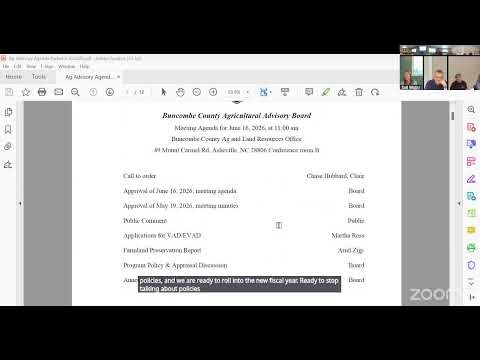
At its June 16, 2026 meeting the Buncombe County Land Conservation Board voted to adopt a preservation program policy that continues the county practice of paying for IRS appraisals on conservation easements after deliberation about cost, liability and equity for landowners.
The Buncombe County Land Conservation Board voted at its June 16, 2026 meeting to adopt a formal preservation program policy that continues the county practice of paying for IRS appraisals used when landowners seek federal tax benefits for donated conservation easements. The motion to adopt the policy, which explicitly included continuing IRS appraisals, was moved and seconded and approved by voice vote.
Staff presented three options for the board to consider: continue paying for all IRS appraisals; pay only for donation easements (leaving grant-funded projects to cover their own IRS appraisal costs); or stop paying for IRS appraisals entirely. The staff member leading the briefing said the issue had been raised after the board asked staff to compare local practice with peer districts and to consult outside guidance.
Board and staff discussion centered on two practical points: cost and perceived private benefit. The staff member said, “that by paying for an individual's IRS appraisal, we are benefiting an individual's taxes,” and noted outside advice from the Land Trust Alliance and some appraisers that paying for an IRS appraisal can create an appearance of private benefit and raise professional-liability concerns. Staff also explained the technical difference between grant-funded appraisals and IRS appraisals: grant-funded appraisals meet grant requirements but generally cannot be used to support a federal charitable-donation claim; an IRS appraisal requires additional analyses (including family enhancement considerations) and is typically more complex and costly.
Board members raised equity and implementation concerns: whether continuing the county practice favors one class of landowners over another, whether it could discourage owners from finding private tax-advantaged options, and whether a middle ground (for example, a capped contribution or reimbursement process) could address cost uncertainty. One board member suggested covering an amount “up to” a fixed cap to limit exposure and allow owners to hire an appraiser of their choosing; staff cautioned about administrative burden for reimbursement programs.
Members also reviewed peer practice: staff reported that Haywood and Henderson counties do not routinely pay for IRS appraisals, and that some land trusts require landowners to cover IRS appraisal costs. Staff told the board that county counsel viewed the liability as manageable but left the final policy decision to the board.
After discussion the board approved the policy package that, as presented and motioned, continues the county-supported IRS appraisal practice. The motion carried by voice vote; a roll-call tally was not provided in the meeting record.
Next steps identified by staff included implementing the adopted policy language, continuing ongoing project work under the program, and bringing any necessary administrative guidance back to the board if staff develops a capped-assistance or reimbursement mechanism.