Get Full Government Meeting Transcripts, Videos, & Alerts Forever!
Get email alerts on the Housing topic
No spam. Unsubscribe anytime.
Kenmore Planning Commission narrows housing strategy to four near-term priorities
Summary
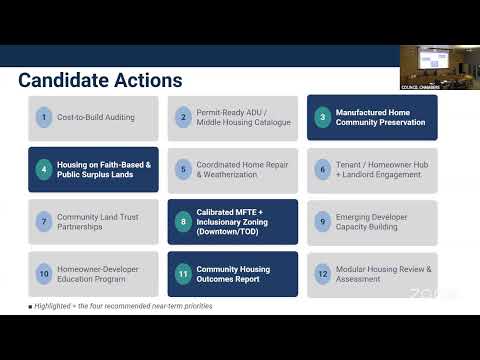
The Kenmore Planning Commission on June 16 directed staff to develop scopes for four near-term actions in its housing strategy: manufactured-home community preservation; using faith-based and public surplus lands; calibrated MFTE/inclusionary zoning; and an annual community housing outcomes report. Commissioners asked for more analysis of expected impacts and outreach plans before final adoption.
Todd Hall, principal planner, told the Kenmore Planning Commission on June 16 that staff and consultant Arch were seeking direction on near-term priorities and scoping for an implementation work program. "We're asking tonight for your direction on a few things," Hall said, framing the meeting as a step to translate policy into an action plan.
Staff presented a logic model and a scored list of 12 candidate actions. Hall and Arch consultant Andrew (introduced as Andrew Bjorn from Arch) identified four recommended near-term priorities: (1) manufactured-home community preservation to reduce near-term displacement risk, (2) leveraging faith-based and public surplus land to expand sites suitable for affordable housing at modest cost, (3) calibrated Multifamily Tax Exemption (MFTE) and inclusionary zoning targeted to downtown/TOD areas to capture income-restricted units, and (4) a community housing outcomes report to track progress and institutionalize accountability.
"This is a low cost, low effort, but high value" mechanism, Hall said of the outcomes report, describing it as the way to "keep the rest of this plan honest." Andrew summarized the logic-model approach as a way to link resources, activities and measurable outcomes so the commission could prioritize what staff should scope next.
Commissioners welcomed the clear framework but pressed staff for more detail about expected impacts and the implementation timeline. Vice Chair Dorian asked for a retrospective analysis of the 2017 strategy: "Could we see an analysis, not right now, obviously, but in a future meeting, of what we have not achieved from the previous plan?" He and several colleagues also pressed for a clear statement tying each candidate action to AMI bands and housing targets so the commission can judge whether the prioritized actions will meet statutory goals.
Members debated whether to add a fifth near-term item (permit-ready ADU plans, tenant/homeowner resource hub, or a step-housing emphasis). Several commissioners praised the idea of permit-ready ADU and middle-housing design catalogs but noted mixed uptake elsewhere and questioned staff capacity and funding for development of catalogs. "If there is a resource opportunity for the city to take advantage of, then we might elevate this," Andrew said, noting potential federal funding and cross-jurisdictional collaborations could change the ranking.
Commissioners also flagged practical implementation questions: the length of time for code or zoning changes, staffing and consultant needs, potential grant opportunities, and community engagement methods that center BIPOC and housing-insecure residents. Staff estimated that some actions could reasonably be scoped and initiated over an 18-month horizon but cautioned adoption-to-completion timelines will depend on the level of code change, council review and available capacity.
The commission did not take a formal roll-call vote on the housing strategy priorities. The chair called for nods and thumbs-up and said staff had "direction on the staff recommendation for the top 4." Commissioners asked staff to return later this summer with scopes, resource estimates, a clearer connection between each action and the city's housing targets, and outreach plans before any final recommendation to the council.
At the start of the meeting, the commission approved the consent agenda by unanimous consent after Commissioner Thompson moved adoption and the motion was seconded.
What happens next: staff and Arch will prepare scoping documents, expected analytic updates (including a refreshed needs assessment), and targeted outreach plans to return to the commission at a subsequent meeting for further direction and refinement before any formal council recommendations.