Get Full Government Meeting Transcripts, Videos, & Alerts Forever!
Get email alerts on the Road And Bridge Budget topic
No spam. Unsubscribe anytime.
Bonner County Road and Bridge workshop raises fuel contingencies, reclassifies investment interest and scales truck purchase
Summary
At a June 16 workshop, Bonner County officials reviewed the Road and Bridge draft budget, agreed to raise gasoline and diesel contingencies amid price volatility, directed staff to reclassify interest-on-investments for capital projects, and narrowed a planned heavy-truck purchase from four vehicles to two while starting a vehicle-replacement discussion.
Bonner County’s Road and Bridge director presented the department’s draft 2026‑27 budget at a June 16 workshop that centered on uncertain state apportionments, accounting treatment of interest earned on savings for capital projects, and large expected increases in fuel and parts costs.
Director Jason (Road and Bridge) told the commissioners he had left some state-driven lines at $0 because “we don't know what the levy is gonna be for next year until we get through the budget cycle,” and recommended treating forest apportionments and some state funds (PILT/SRS) as unanticipated revenue rather than including them as guaranteed receipts. He also highlighted interest accumulated in a savings account for bridge projects and warned that treating that interest as operating revenue can reduce the department’s levy: “If I drop $1,800,000 in anticipated revenue on this, it's gonna look like I got all this funding in here, and they're gonna reduce my levy amount,” he said.
Commissioners and finance staff pressed for clearer, consistent accounting treatments. Clerk/auditing staff recommended two options: budget the interest line at zero and sweep accumulated interest into a capital improvement account at year-end, or create an offsetting capital expense line that preserves the interest without inflating operating revenue. Treasurer Clarissa Coster confirmed the investment-interest balance at about $215,002.81 year to date and staff agreed to reconcile exact ledger detail with external auditors.
A substantial portion of the meeting focused on rising operating costs. The director said the department faces higher prices for parts, plow bits (tungsten-carbide components), tires and fuel. Commissioners pushed for a more conservative, consistent forecasting method—either a three‑year average or a fixed tolerance around that average for lines that vary year to year. One commissioner summarized the board’s preference for consistency: “There should be...we wanna be within 2% of what our last 3 year average is,” he said.
After discussion, staff and the board agreed to raise fuel contingencies. Clerk/staff presented computed increases and the group coalesced on a roughly 20% uplift for the gasoline baseline (from $120,000 to about $144,000) and a larger contingency for diesel (targeting about $1,000,000) to reflect uncertainty and wildfire/seasonal needs. The board also agreed to increase the vehicle-lubricants line and to watch shipping/freight closely because shipping costs are driven by diesel.
On consumables, the director supplied price quotes showing plow-bit costs spiking (one quote showed ~ $21,000 for units previously priced much lower) and requested an additional $20,000 in the bit line; commissioners approved reallocations to cover that increase but asked staff to keep clear documentation of one‑time receipts and quotes so three‑year comparisons are meaningful.
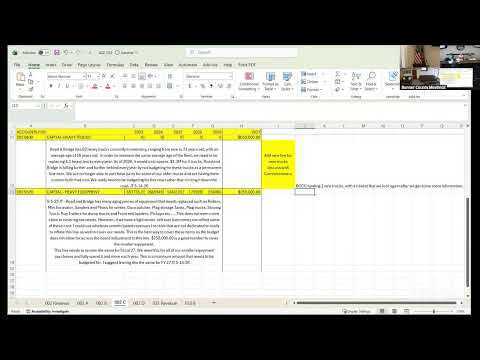
Capital requests drew vigorous debate. The director proposed buying four heavy dump trucks (a capital request originally estimated around $1.3 million), noting the county’s fleet averages about 16 years in age. Commissioners urged caution given competing increases elsewhere in the budget and proposed starting with two trucks this year and using any year‑end surpluses or contingency overages to seed a formal vehicle-replacement program. One commissioner urged creating a standing replacement line: “There has to be a vehicle replacement plan. It has to be its own budget item,” he said.
Next steps: staff will reconcile Munis/ledger entries and auditors’ recommendations for the one‑off buyback and lease‑refund items that distorted some prior-year comparators, reclassify or create offset lines for interest-on-investments so capital savings do not reduce the levy, and return with updated numbers. The board agreed to revisit remaining capital allocations and finalize the Road and Bridge budget after those accounting changes and updated forecasts are provided.
This workshop did not include any formal motions or recorded votes; commissioners directed staff on accounting treatments and budget adjustments and resolved to reconvene to finish remaining capital decisions.