Get Full Government Meeting Transcripts, Videos, & Alerts Forever!
Get email alerts on the Jackson Street Redevelopment topic
No spam. Unsubscribe anytime.
City presents Jackson Street redevelopment plan and digital‑twin after $1.3M EDA award and $1.6M RDA match
Summary
Consultants and community leaders presented a multifaceted Jackson Street redevelopment report funded by a $1.3 million EDA grant and a $1.6 million RDA match. The presentation described community cohorts, a developer training program, infrastructure analysis, a proposed first project seeking 9% tax credits for a $20,000,000 mixed‑use development (about 50 units with ground‑floor medical services), and a public digital‑twin visualization (report only; no Agency action).
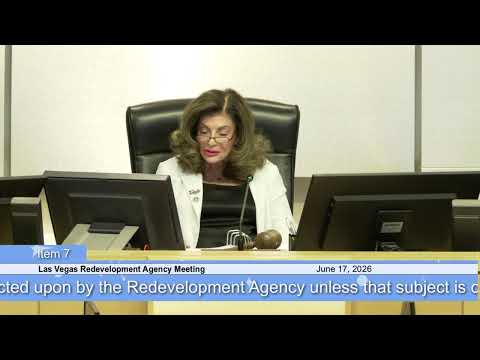
The Redevelopment Agency received a comprehensive report on June 17 on plans to revitalize Jackson Avenue in Las Vegas’s historic West Side. Staff and a multi‑consultant team described community‑led capacity building, infrastructure due diligence, market analysis and an interactive digital‑twin intended to help residents and investors visualize redevelopment scenarios.
Dina Babbski, director of Economic and Urban Development, said the city secured a $1,300,000 Economic Development Administration (EDA) grant and matched it with $1,600,000 from the Redevelopment Agency. She introduced consultants and emphasized that community leaders and legacy landowners helped shape grant goals to remove blight and preserve cultural assets.
Melvin Valentine, project manager, described organizing the Jackson Street Alliance (JSA) as a central, community‑led element of the work and noted the Alliance was acknowledged by the Council on April 1, 2026. “The community was at the table,” Valentine said, and he described cohorts and trainings designed to prepare landowners and local developers to lead projects.
Torian Gordon said the consultant team partnered with Freddie Mac to run a developer program and training cohorts to build technical capacity, connect owners to experts and to attract capital. Jayla Hart, lead analyst, summarized the market and economic impact analysis and said a first‑phase mixed‑use scenario could produce about 300–540 new jobs (largely construction), $30–$53 million in labor income, $19–$34 million in annual local spending, roughly $1.7 million in local sales tax and $43–$76 million in additional regional GDP.
Brian Gantt of Wood Rogers presented infrastructure findings: the 2022 Jackson Avenue roadway improvements left surface transportation in reasonably good shape for projected build‑out (with recommended transit frequency increases), an existing 8‑inch sanitary sewer line with capacity but aging condition that may require lining or future replacement, adequate water pressure for fire flow, approximately 30% spare capacity in downtown electrical substations at a corridor scale, an estimated 80,000 cubic feet per hour capacity from Southwest Gas for likely uses, and existing conduit and fiber options for broadband.
Derek Fleming (HR&A) described the cultural‑tourism approach and community engagement (more than 200 participants), and Arrow AI/REI (Glenn Nowak and Victory Binobaro) demonstrated a digital twin that overlays existing conditions, consultant scenarios and key performance indicators in a publicly accessible, interactive tool; presenters said visuals are illustrative and that a conversational AI agent is included to make technical findings accessible to non‑technical users.
Presenters said the first project submitted to the City seeks 9% tax‑credit funding for a roughly $20,000,000 development (about 50 residential units with ground‑floor medical services) and that JSA landowners would have an equity stake in the project. Presenters emphasized preference for mixed‑use, mid‑scale development that preserves the corridor’s history and community character rather than very tall towers.
Deidre Edmond Drew, CEO of the Jackson Street Alliance, addressed the Agency during citizen participation and called the presentation “a labor of love,” urged continued partnership and celebrated the Alliance’s advocacy to restore Jackson Avenue as a cultural corridor.
This was a report‑only item and no action was required from the Agency at the meeting.