Get Full Government Meeting Transcripts, Videos, & Alerts Forever!
Get email alerts on the Critical Areas Wetlands topic
No spam. Unsubscribe anytime.
Sedro‑Woolley planning commission debates new wetland buffers, seeks flexibility from state guidance
Summary
City planning staff and consultant Alex of Facet outlined Ecology and Fish & Wildlife guidance that would broaden wetland and riparian protections; commissioners pressed staff for flexibility on habitat scoring, potential 150–300 foot setbacks and small‑wetland exemptions and asked staff to return with Ecology nd Fish & Wildlife feedback.
Alex, a Facet consultant, told the Sedro‑Woolley Planning Commission on June 16 that the proposed update to Chapter 17.65 aims to align the city with state law and "best available science," including Ecology nd Fish & Wildlife guidance for wetland buffers and riparian management zones.
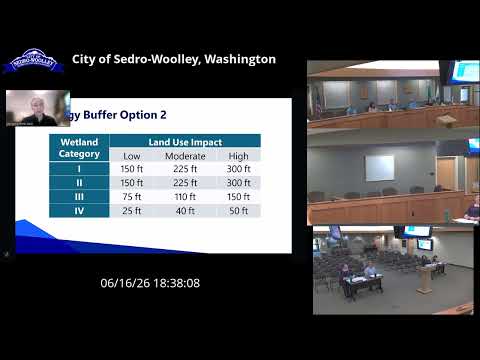
"You're required to demonstrate no net loss," Alex said, summarizing the core legal test jurisdictions must meet when they update critical‑areas rules. He reviewed Ecology's category framework (Category 1 = 150 feet, Category 2 = 110 feet, Category 3 = 50 feet, Category 4 = 25 feet) and three model options that either rely on fixed widths or incorporate habitat scores and land‑use intensity to vary buffer widths.
Commissioner Fattizzi raised repeated concerns about how habitat scores are assigned in the field and how small changes in those scores could trigger much larger setbacks. "A 300 foot setback is a massive deal," he said, warning that high land‑use intensity designations and SPTH‑based riparian zones could remove substantial buildable area in a small city. Several commissioners said developers and home‑owners frequently see variation between consultants and asked how the city would handle conflicting delineations.
Staff and consultant responses: Alex said habitat scores are determined as part of a wetland delineation using the 2014 wetland rating form and that a "qualified professional" must prepare the delineation, but he acknowledged the score can vary by consultant. Staff noted the city has a third‑party environmental reviewer under contract to provide a check when parties disagree.
On riparian protections, Alex described Fish & Wildlife's site‑potential‑tree‑height (SPTH) tool and its recommendation to regulate riparian areas as riparian management zones (RMZs) rather than simple dimensional buffers. He said RMZ widths within Sedro‑Woolley would vary (the consultant nalysis showed ranges roughly between about 102 and 245 feet in the city) and that adopting SPTH could increase the number of legally nonconforming structures and would likely require third‑party review and higher costs for landowners.
Alex also summarized a small‑wetlands exemption included in Ecology's model ordinance: certain low‑function Category 4 wetlands under specific area thresholds could be administratively authorized to be filled without a mitigation requirement. "The city currently doesn't have any small wetlands exemptions," he said, and added that the model language would allow the city some additional administrative flexibility for small, low‑function wetlands.
Commissioners pressed timing and appeal questions. Alex said jurisdictions technically face statutory deadlines tied to comprehensive‑plan adoption and must document why they might depart from Ecology nd Fish & Wildlife guidance; he warned deviations increase the risk of Growth Management Hearings Board appeals. Staff said the city is actively working on the update and will document the record to demonstrate how any change meets the "no net loss" obligation.
What happens next: Commissioners asked staff to carry their concerns to Ecology and Fish & Wildlife—particularly requests for more local flexibility around Category 3 wetlands and high land‑use intensities—and to return next month with agency feedback and any relevant Growth Management Hearings Board decisions. The commission did not take formal action on the regulatory changes at the June 16 meeting.