Get Full Government Meeting Transcripts, Videos, & Alerts Forever!
Get email alerts on the Traffic Signals topic
No spam. Unsubscribe anytime.
Council approves $108,558 pilot to test emergency vehicle signal preemption
Summary
The Normal Town Council voted to waive formal bidding and accept a $108,558 quote from Traffic Control Corporation for a pilot emergency vehicle signal-preemption project; staff said the test will cover about six'seven intersections, run several months and evaluate equipment, integration and maintenance needs.
The Town of Normal approved a $108,558 contract to test emergency-vehicle signal preemption at a handful of intersections, voting unanimously after council members pressed staff on scope, success metrics and data security.
The resolution waives the formal bidding process and accepts a Traffic Control Corporation quote to install preemption equipment at roughly six to seven intersections on Raab Road between Parkside and Towanda as a test of a system that could eventually be expanded to the town's 65 signalized intersections. "This particular test project is designed to look at the equipment specifically, and what sort of implementation challenges we will have integrating it with the CAD," said Mister Otto, staff member leading the presentation. "We're really looking to get an idea of how it functions, what it takes for maintenance, and what it takes for staffing."
Council Member Lorenz said she supported the safety focus but asked how the town will determine success. "How will we determine if this investment is successful?" she asked. Otto replied that the pilot's immediate goals are to document cost, staff and maintenance needs and to understand integration challenges; he said a systemwide benefit (for example, measurable reduction in response times) would require broader implementation beyond the pilot. "A success would be that we have an understanding of cost, how much staff time, how much maintenance over time, and implementation requirements," Otto said.
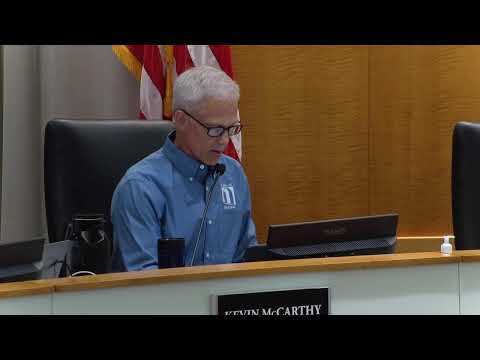
Council Member McCarthy pressed on data handling and security and asked whether the system is cloud based. Otto confirmed the system is fully cloud based and that the project team will need to work through data-storage and security issues as integration proceeds. "Those are questions that still need to be sorted as you go through this process," McCarthy said.
Council members also asked whether using this vendor now precludes a later competitive process; staff said the vendor is the authorized local provider for the proprietary AI Glance system, so a future bid with the same specifications likely would list the same vendor unless the town changes systems. Staff recommended the pilot as a low-risk step before committing to wider implementation and cited positive experiences from nearby Bloomington and other communities.
The council approved the item on a recorded roll call vote with all members voting in favor. Staff said the expected timetable is three to four months for installation and an additional three to six months of evaluation. The next procedural step is implementation of the pilot; staff indicated council would see results and a recommendation about expansion once evaluation is complete.