Get Full Government Meeting Transcripts, Videos, & Alerts Forever!
Get email alerts on the Redevelopment Finance topic
No spam. Unsubscribe anytime.
Madelia council advances redevelopment plan, sets public-hearing timetable and discusses hospital loan timing
Summary
At a special Madelia meeting, council members approved a professional services contract with Northland Securities and a preliminary resolution authorizing loan procedures; they set a public hearing for July 27 and discussed funding timing for a related hospital project, including a reported $1.4 million state capital award and potential bridge funding.
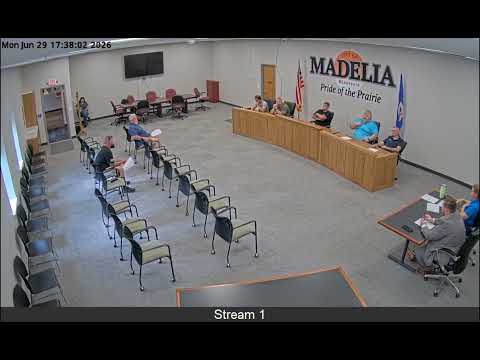
The Chair called a special meeting and led the Council in approving a Professional Services Agreement with Northland Securities Inc. and a preliminary resolution (Resolution 20 26-10) authorizing loan procedures tied to a redevelopment project and related financing for a local hospital. Both motions were seconded and carried without recorded opposition.
The Council outlined a schedule for next steps: actions following June 29, a planned July 13 meeting to call a public hearing, and a public hearing on July 27. The Chair said the timeline assumes completion of necessary agreements in the weeks that follow and that, if agreements are not finalized, the Council could delay action to the first regular meeting in August or hold another special meeting.
Why it matters: the timeline and approvals shape when the city can make a loan available and whether private and state funding can be combined to cover capital needs at a facility several speakers referenced. The Council’s decisions will determine whether short-term bridge funding is needed to maintain operations while agreements and underwriting are finalized.
Council discussion focused on timing and cash flow. The Chair listed near-term receipts the organization was expecting: “We’ve got a Medicare payment that’s coming Wednesday for a $100,000. Got another payment that’s coming in for $40,000,” and warned, “We almost didn’t make payroll last Friday.” The Chair said those receipts and other collections will affect whether funds can flow in August as hoped.
Members flagged procedural and legal constraints on moving municipal funds. The Chair cautioned that the city cannot simply reallocate existing city funds into a loan or place them in the EDA without following required steps: agreements must be completed, approvals obtained and funds rerouted through the correct legal processes before disbursement.
On external funding, the Chair reported the city had been told it was approved for $1,400,000 in state capital funding for capital projects but added a caveat: the funds require a suspension (a condition) that the city does not currently have in place, and the funding has limits on how property-related expenses may be used. The Council also discussed private philanthropy: the Chair said representatives from the VIN Foundation and prospective anchor donors were enthusiastic and that prior investors (referred to in the discussion as PRI investors) might fill remaining gaps once the loan is in place.
Council members described the intended use of loan proceeds: pay off a short-term line of credit at Bridal Bank to release collateral, free the organization’s control over assets, and leave modest proceeds to reduce accounts payable. The Chair noted Heartland funds were expected to act as short-term bridge financing to carry operations until the loan and other funding came through.
A presenter reported receivables had been reconciled and were roughly half what was typical; the presenter said bringing billing and coding in-house has produced an uptick in collections, but uncertainty about timing remained. The presenter framed the situation as unpredictable: some payer flows vary and collections do not follow a steady schedule.
Next steps: The Council will call the public hearing at its July 13 meeting and hold the public hearing on July 27. If agreements and underwriting are complete and no substantive objections arise at the hearing, the Council could act by the end of July or in early August; however, members repeatedly cautioned that unexpected delays could push decisions later.
The Chair closed the agenda item by thanking partners and staff for their efforts on the project.