Get Full Government Meeting Transcripts, Videos, & Alerts Forever!
Get email alerts on the Land Use topic
No spam. Unsubscribe anytime.
Hearing examiner approves new Buddhist temple at 14334 Yelm Highway SE
Summary
The City of Yelm hearing examiner granted a special‑use permit for the Wat Pracham Rangzi Buddhist temple at 14334 Yelm Highway SE, approving a replacement temple and residence with conditions; staff noted habitat mitigation, stormwater controls and private water/wastewater systems, and the written decision will follow in about a week.
Mark Scheibmeyer, the City of Yelm hearing examiner, orally approved a special‑use permit for the Wat Pracham Rangzi Buddhist temple at 14334 Yelm Highway Southeast, saying "I'm gonna go ahead and approve the application, as proposed with the conditions recommended by city staff." The approval was issued at the close of a public hearing on the application (LD2026-0068); Scheibmeyer said he would reduce his oral decision to written findings within about a week to two weeks.
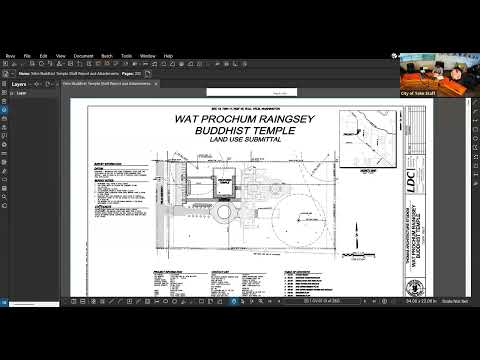
City planning staff (Kohler) told the examiner the 5‑acre parcel was annexed to the city in March 2026 and—under the interlocal agreement with Thurston County—would be processed under Thurston County rural residential rules. Staff said the project would replace the existing temple and accessory structures with a modern combined temple and residential facility, add a new on‑site well and two septic systems (one for the temple, one for residents), and include three stormwater facilities and a 15‑stall parking area.
Staff reported the site is covered by Thurston County's Habitat Conservation Program (HCP). "The project is proposed to impact approximately 24,310 square feet of Mazama pocket gopher habitat and purchased 0.893 mitigation credits at a cost of $23,823.80," Kohler said. Staff told the hearing that issuance of the county certificate of inclusion confirms the project is subject to the HCP's avoidance, minimization and mitigation measures.
Applicant representatives described technical measures they said are intended to protect groundwater and control runoff. Maggie Hausen (applicant representative) said the design includes two bioretention facilities for parking runoff and an underground infiltration trench for roof runoff; she added that the infiltration trench would be registered as an underground injection control well with the Department of Ecology. "We will be constructing a new combined temple and residence on‑site," Hausen told the examiner during the presentation.
City staff and the city's engineer, Reza, explained that the city's code requires developments within 200 feet of a water or sewer main to connect when public infrastructure is available; because the property was annexed recently and was processed under county rules per the interlocal agreement, staff said the city waived immediate frontage improvements for this parcel but typically uses a 15‑year deferral arrangement when city road work is anticipated. The applicant also proposed a fire‑truck turnaround to improve emergency access.
The applicant said the parking proposal reflects Thurston County standards: staff referenced a county requirement of 17 stalls for the use with an allowance to reduce; the applicant proposed 15 stalls and said on‑site overflow can accommodate larger annual festival events subject to separate special‑event permits. The transcript records the county standard number and the applicant's proposed 15 stalls as presented at the hearing.
A brief public comment period produced one speaker, Steven Craig, who said he strongly supported the project and praised the architect's work. Scheibmeyer said there was no need for rebuttal testimony and that he was satisfied the proposal met applicable criteria and conditions recommended by staff.
The examiner's oral approval is effective as an initial administrative decision; Scheibmeyer said he will prepare written findings of fact and legal conclusions to formalize the decision so follow‑up permitting and inspections can proceed. The written decision is expected to be issued to the city within roughly one to two weeks.