Get Full Government Meeting Transcripts, Videos, & Alerts Forever!
Get email alerts on the Surveillance Technology topic
No spam. Unsubscribe anytime.
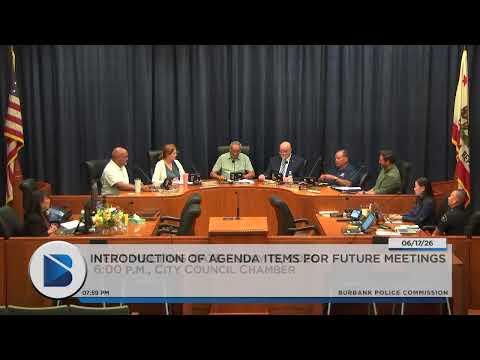
Burbank commission narrows and agendizes review of public-safety surveillance technology
Summary
After a tied vote on a broad proposal, commissioners approved a narrowed motion to agendize discussion and possible recommendations on specific public-safety technologies, including ALPRs, cameras, marketplace data and unmanned aircraft systems.
The Burbank Police Commission voted to agendize a future discussion and possible recommendations on the department’s use of public-safety technology, data storage and procurement after narrowing the motion’s scope to a specified list of technologies.
An initial, broader motion to agendize public-safety technology debate resulted in a 3–3 tie and failed to pass. Commissioners then debated narrowing the subject. Commissioner 10 proposed specifying technologies under review — automatic license-plate readers (ALPRs), public-safety cameras, marketplace-data tracking tools, unmanned aircraft systems, real-time information systems and biometric recognition technologies — and the commission approved the amended motion.
Chief Clintero told commissioners the department has previously presented an overview of some systems (for example, a prior 'flock' presentation) and said the department currently does not operate biometric recognition systems as some residents have feared. "We don't have any surveillance technology not the way that you believe it is being used," the chief said, adding that the department would be willing to present a concise briefing so commissioners have the same baseline of information.
Commissioners who supported the amended motion said they want a focused conversation about existing and planned technology, data-retention policies and procurement practices. Commissioners who opposed the initial broader motion raised concerns about scope and public notice, arguing the public should understand what precise systems would be discussed.
The commission approved the narrowed agendize motion and will schedule the discussion at a later meeting; commissioners recommended coordination with the department for any presentation materials and follow-up briefings.