Get Full Government Meeting Transcripts, Videos, & Alerts Forever!
Get email alerts on the Energy Storage topic
No spam. Unsubscribe anytime.
San Benito County planners continue review of draft battery‑storage rules, ask staff for parcel maps and chemistry ban
Summary
The Planning Commission reviewed a draft battery energy storage (BESS) ordinance focused on siting, safety and mitigation; commissioners asked staff for GIS maps showing feasible parcels under varying setback models and requested a prohibition on certain battery chemistries before sending a recommendation to the Board of Supervisors.
The San Benito County Planning Commission on a 4–1 vote continued consideration of a draft ordinance to regulate battery energy storage systems, asking staff to return in August with parcel maps that model the ordinance’s siting layers and a proposal to ban specific battery chemistries.
Abraham Prado, the county’s director of planning and building services, presented the draft ordinance and described the Board of Supervisors’ recent moratorium extensions on BESS applications (initial 45‑day moratorium adopted March 10, 2026, extended April 28 and extended again on June 9). The draft would add new section 25.08.032 to the county code and revise chapter 25.03 zoning tables to specify where BESS would be allowed, allowed with a conditional use permit, or prohibited.
The ordinance reserves BESS sites outside city limits for certain zoning districts, requires conditional use permits in many agricultural and public‑quasi‑public zones, and would generally prohibit BESS in residential zoning. It also ties siting to the California Department of Conservation’s Farmland Mapping and Monitoring Program (FMMP) so that conditional use permits would not be allowed on prime farmland or land of statewide or local importance shown on the FMMP maps unless exceptions are met.
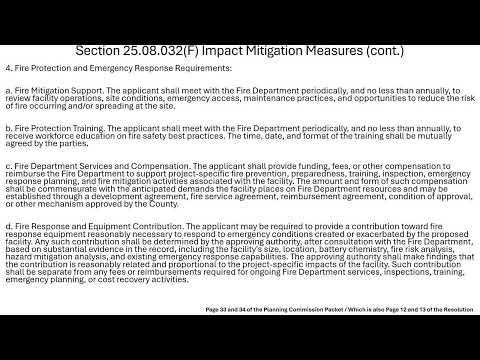
On safety and operations, the draft includes: a half‑mile separation from incorporated city limits, spheres of influence and identified census‑designated places; minimum setbacks of 300 feet from sensitive receptors, 100 feet from property lines and public roads, and 500 feet from residences; prohibitions in very high and high CAL FIRE hazard severity zones; NFPA and UL standards; 24/7 monitored security systems; native drought‑tolerant screening; noise limits (average not to exceed 65 dB); and construction hour limits consistent with county practice. Applicants would be required to work with emergency response agencies on emergency response plans and to provide technical third‑party analyses (plume modeling, fire and chemical hazard analyses, aviation impacts) as part of the application.
The draft also requires a financial assurance plan and includes an on‑site dedicated water requirement: unless an alternative supply is approved by the fire agency having jurisdiction, a BESS project must maintain an on‑site pressurized water system with 50,000 gallons of dedicated storage to protect exposures and support containment operations. Fire Marshal Charlie said the water requirement is intended to protect adjacent vegetation and structures and to provide hose flow for containment rather than to extinguish thermal runaway events, which the marshal said are often handled by containing and allowing involved modules to burn out.
Public commenters represented a mix of developers, clean‑energy agencies, labor and residents. Long Road Energy asked the commission to refine language that may add costs or uncertainty and to avoid provisions that effectively push projects to the California Energy Commission’s AB‑205 process. Central Coast energy representatives and local clean‑energy advocates urged strong safety, monitoring and decommissioning standards but asked staff to map whether the proposed layers would leave any feasible parcels for development. Labor and contractor representatives urged requiring C‑10 contractors and certified electricians and suggested workforce training and certification language be included.
Commissioners said they favor strong safety protections but worried the cumulative effect of half‑mile setbacks, farmland exclusions, fire hazard exclusions and floodplain limits could amount to a de facto county‑level ban. Multiple commissioners asked staff to produce GIS mapping that layers FMMP farmland exclusions, CAL FIRE hazard zones, FEMA floodplains and the half‑mile city/CDP buffer to show what parcels would remain under different setback options (half‑mile, 1,000 feet, 330 feet). Several commissioners also requested that the ordinance explicitly prohibit battery chemistries with higher thermal‑runaway risk.
The commission directed staff to return with: (1) GIS parcel maps showing parcels that remain feasible under the draft’s siting layers and several alternative setback models, (2) language for a chemistry prohibition to consider, and (3) additional details about local benefit measures (development agreements and mitigation mechanisms to cover county costs). The motion to continue to August passed 4–1.
The draft remains under review and, pending the commission’s recommendation, will be forwarded to the Board of Supervisors for consideration. The board previously authorized a moratorium on BESS applications while staff completed the ordinance work.