Get email alerts on the Economic Development topic
No spam. Unsubscribe anytime.
Fernley council directs staff to keep developing data-center zoning rules, schedule workshops and site visits
Summary
After a broad discussion about water, noise and siting risks, the council voted 3–0 to direct staff to continue drafting data-center ordinance options, hold public workshops and arrange tours of existing facilities for learning and outreach.
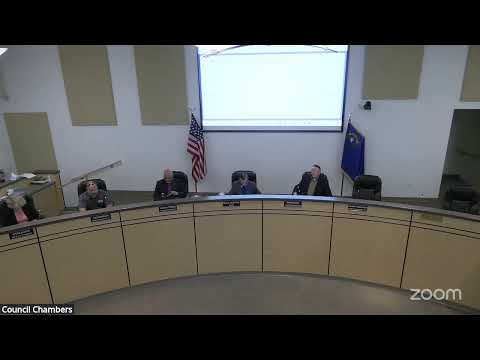
Fernley City Council on June 17 directed planning staff to continue developing draft zoning tools to regulate data centers, schedule public workshops and arrange site visits to existing facilities so the city can refine development standards and public outreach.
Planning Director (transcript: Michelle Grama) presented two draft approaches: Version 1 would permit data centers in industrial zones through conditional-use permits plus development agreements; Version 2 would add a data-center overlay district that requires a zoning map amendment prior to conditional-use approval, giving council more control over siting. Staff proposed development standards that would include closed-loop cooling, water studies, noise monitoring, emergency-response plans, 200-foot setbacks from property lines, a 1,000-foot buffer from residentially zoned parcels (roughly 0.2 miles), 20 feet of landscaping along streets, screening walls, and decommissioning procedures.
“Right now these are very draft ordinances,” the planning director said, noting staff had researched model ordinances, best practices and neighboring-county work and asked council which approach to advance. Council members pressed staff on water use, equity with other heavy industrial users, and notification and outreach. Councilman Hannon asked whether the city should consider similar standards for other water- or energy-intensive industries so regulation is fair. “I would like to have workshops before we decide what direction,” Hannon said, urging comparative information on water use by households versus data centers.
City Attorney Aaron Mortensen said the city can set restrictions on how water may be used by future facilities and limit wasteful uses, while cautioning against requiring more water dedication than the project needs. Councilman Torres and others asked staff to conduct tours of actual data centers and to involve Lyon County in drafting. Several council members favored the overlay option to better control locations, but all supported more public engagement. Councilman Mendoza moved to direct staff to continue gathering information, schedule workshops and tours, and prepare a draft ordinance; Councilman Hannon seconded. The motion carried 3–0.
Next steps: staff will continue drafting the ordinance, plan public workshops and coordinate site visits; staff will return with refined draft(s) based on input.
AI generated
The text on this page is AI generated. Summaries, highlights, analysis, and video transcripts are all produced from the original source material.
AI can make mistakes, so if you spot one, and we will fix it for everyone.
Note: the source content is unaltered by us. Any content source we link to, be it a video, an audio recording, or a document, is presented exactly as its publisher released it. That publisher is usually a government body, sometimes an individual official or another organisation.