Get Full Government Meeting Transcripts, Videos, & Alerts Forever!
Get email alerts on the Urban Forest topic
No spam. Unsubscribe anytime.
Menlo Park arborist reports 19,000 public trees; staff, residents press for more canopy in Belle Haven
Summary
City arborist Jillian Keller told the Environmental Quality Commission the city manages about 19,000 public trees, planted 132 and removed 135 this fiscal year, and will partner with Canopy to plant about 70 trees in Belle Haven; residents urged more transparency on maintenance schedules, more plantings in underserved neighborhoods, and consideration of water support for new plantings.
Menlo Park's city arborist told the Environmental Quality Commission on June 17 that the city manages roughly 19,000 public trees and is moving forward with an early-action tree planting plan that will prioritize the Belle Haven neighborhood.
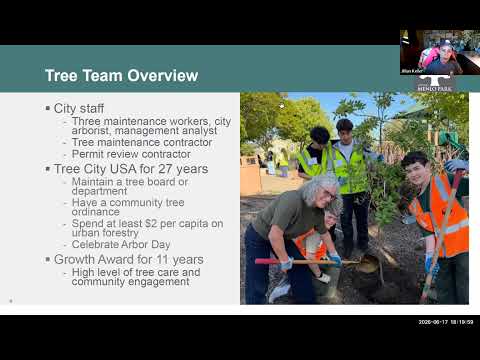
"We have about 19,000 public trees," City Arborist Jillian Keller said during a presentation to the commission, adding the city planted 132 trees, pruned about 3,000 and removed roughly 135 trees during the fiscal year. Keller described the department's staffing and contract structure, noting the city operates a five-year rotating trimming schedule and relies on a contractor, West Coast Arborist, for routine maintenance inspections.
Joanna Chen, a public works management analyst, outlined three types of heritage-tree permits (dead/declining, development-related and emergency removals) and explained that development-related removals require additional documentation, alternative-design analysis and an appraisal-based replacement requirement. Chen said recent administrative guidelines will be updated to reflect current construction-cost thresholds and that staff will coordinate with the city attorney on what legal changes are possible.
The commission heard sustained public comment from Belle Haven residents, who urged the city to address what they described as a disparity between tree removals and plantings in their neighborhood. "When I looked at those two bars for our neighborhood versus everybody else's neighborhood, I started getting really mad," Belle Haven resident Nina Woke said, urging the city to require replacement when development removes mature trees.
Canopy, the local urban-forest nonprofit, will serve as a planting partner, Executive Director JP Renaud said. "Beginning next fiscal year, Canopy will serve as an official partner to the city with a contract to plant 70 additional trees in Belle Haven," Renaud said, emphasizing community engagement and resident stewardship as essential to tree survival.
Keller described the early-action timeline: outreach in Belle Haven began in May with Canopy and staff hopes to start planting when conditions are cooler and wetter — likely late October through winter — to improve establishment success. "We're hoping to plant at least half of the trees this winter and finish in January–February," Keller said.
Residents asked for clearer public information on maintenance cycles and how to request inspections or plantings. Keller pointed commissioners and residents to the city's ACT Menlo Park (SeeClickFix) service request system for reporting trees and to a public tree grid map on menlopark.gov/trees that shows rotating five-year maintenance zones. She also said the city maintains a small nursery (about 20 replacement trees currently) and tries to match the right species to a site.
On appeals and enforcement, Keller said staff sometimes finds discrepancies between historical aerial imagery and current project surveys and will request retroactive permits and replacement when possible. She noted an appeal for a large development at 68 Willow Road was withdrawn and the applicant elected to preserve the street tree in question.
Keller also described efforts to transition the tree crew's equipment to electric tools and to hire a tree supervisor to expand capacity. Staff said administrative guidelines are being revised and will be reviewed with legal counsel and that the commission can provide feedback when drafts are available.
The commission thanked staff and residents for the input and discussed possible future agenda items to revisit administrative guideline updates and to provide reaction from the EQC. The presentation closed with staff committing to explore a public-facing maintenance dashboard and to continue outreach in Belle Haven with Canopy.
The EQC will consider next steps and possible follow-up at future meetings.