Get Full Government Meeting Transcripts, Videos, & Alerts Forever!
Get email alerts on the Iran Mou topic
No spam. Unsubscribe anytime.
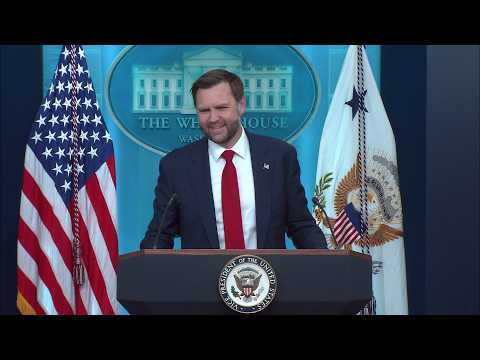
Vice President defends Iran memorandum, says U.S. will not transfer funds without verified compliance
Summary
At a White House briefing, the Vice President described a new memorandum of understanding with Iran as conditional: any economic benefits or sanctions relief would be tied to verifiable changes in Iranian behavior, and he rejected the notion that the U.S. would give Iran money without compliance.
Vice President said on the record that the United States will not hand over money to Iran under the recent MOU unless Iran "comply fully and change their behavior." He described the deal as a conduct-and-verification arrangement that opens a short window for diplomatic progress while preserving U.S. economic and military leverage.
The Vice President framed early indicators as positive, saying "last night, 12,500,000 barrels of oil went through the Strait Of Hormuz" and noting that gasoline prices had fallen below $4 a gallon. He argued those shifts show the MOU is already easing regional energy disruptions while making clear that any further relief is contingent on Iranian action.
Why it matters: The administration presented the MOU as a negotiated trade—verification steps, inspections and the destruction of enriched material in exchange for phased easing of the blockade and targeted sanctions relief. "The only way that they would ever get any benefit of the bargain… is if they comply fully and change their behavior," the Vice President said, repeating that the United States would not "give up a cent" to Iran.
Reporters pressed the administration on several specifics. On timing, the Vice President said the 60-day review period "officially started today" despite earlier reporting about signature and publication timing. He said the MOU was signed Sunday but that U.S. officials accommodated Iran's request to delay public release to allow a Farsi translation to be checked by the State Department.
On enforcement and verification, the Vice President said the administration would rely on inspectors, an enforcement regime and the destruction of enriched stockpiles. "Words don't matter, ladies and gentlemen. We're about verification," he said, describing the pact as rewarding conduct rather than promises.
On sanctions and congressional authority, the Vice President said the administration has an OLC opinion that it can temporarily lift certain sanctions without immediate congressional approval and that the White House plans a formal congressional briefing soon.
On the economic question of whether allowing Iran to sell oil constitutes a lifeline, the Vice President rejected that characterization. He said most frozen Iranian assets are not held in U.S. accounts, estimated the Iranian economy had suffered roughly $1 trillion in damage over the prior three months and argued limited oil receipts would not reverse that damage. He added that improved transparency of financial flows would allow the U.S. to spot and block transfers to designated terrorist groups.
Regional implications: The Vice President said the MOU contemplates a regional security framework—mentioning Oman, the Gulf partners and what he called the "Gulf Coast Coalition"—to prevent future choke points in the Straits and to reduce violence between Israel and Lebanon-connected actors. When asked about Israeli objections, he said his conversations with Israeli leaders did not match some press reports and reiterated U.S. support for Israel's right to self-defense.
The administration repeatedly said sanctions and other measures could be reinstated if Iran reverses course. "No sanctions will come off unless they perform the benefit of the bargain, and every sanction will come back on," the Vice President said.
The briefing closes with a planned follow-up: the administration will brief Congress and continue technical negotiations in Switzerland, dependent on Iran's willingness to participate. The Vice President said he expects technical talks to begin soon and vowed to judge the agreement on actions taken, not just signed words.