Get Full Government Meeting Transcripts, Videos, & Alerts Forever!
Get email alerts on the Physician Review topic
No spam. Unsubscribe anytime.
Pain committee endorses medical board recommendations after Dr. Khalil discontinues telemedicine for opioid prescribing
Summary
Dr. Khalil told the Arkansas State Medical Corps Pain Committee he stopped telemedicine for patients prescribed opioids and is implementing random urine drug testing and other safeguards; the committee moved to adopt the medical board's recommendation and urged timely CME compliance.
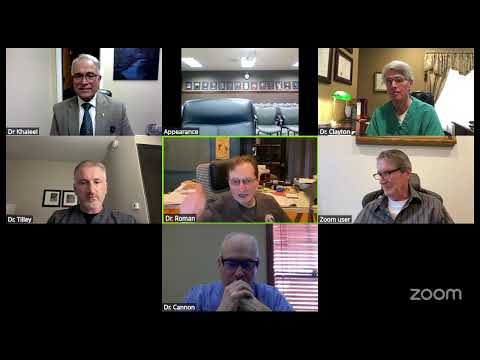
Dr. Khalil appeared before the Arkansas State Medical Corps Pain Committee to discuss his practice and the medical board’s referral; committee members endorsed the board’s recommended corrective steps after Dr. Khalil described specific practice changes, including an end to opioid telemedicine and enhanced urine drug testing.
Chair Dr. Ramon reminded the panel that the committee’s role is advisory and that its goal is to keep physicians practicing safely in the community. Dr. Khalil described a long regional practice and said he has "discontinued and stopped" telemedicine for patients prescribed opioids as of Dec. 1, citing concerns about remote monitoring for controlled substances. "All the telemedicine has been discontinued and stopped as of December 1," he told the committee, and said he has hired extra staff to manage random urine drug screens and to flag violations for his review.
Committee members reviewed charting practices and asked about objective imaging and outside consultations in several records. Dr. Khalil said he is re-checking imaging and specialty input where appropriate and that he documents exceptions for patients with complex conditions such as tethered-cord syndrome. The panel also raised polypharmacy concerns after seeing combinations that included muscle relaxants, benzodiazepines and stimulants; Dr. Khalil said he stopped prescribing those substances and will document exceptions strictly.
There was some back-and-forth in the transcript about the quantity and timing of CME hours the medical board required for Dr. Khalil: Dr. Khalil told the panel he was prepared to take a substantial amount of CME quickly (he referenced "30 hours in 60 days"), and committee members suggested that spreading training over several months might be more practical while still meeting the board's expectations. The committee accepted a motion to follow the medical board’s recommendation; Dr. Khalil said he would comply with the board’s conditions.
Next steps: the committee’s endorsement will be included in the advisory record to the medical board. Dr. Khalil said he will continue to document charting improvements, complete the required CME, and maintain enhanced urine drug-screening procedures.