Get Full Government Meeting Transcripts, Videos, & Alerts Forever!
Get email alerts on the 911 Consolidation topic
No spam. Unsubscribe anytime.
Fayetteville council adopts joint resolution to pursue consolidated 9-1-1 with Cumberland County
Summary
The council voted unanimously to adopt a joint resolution asking the county to form a joint governance body and to complete an interlocal agreement within 60 days to consolidate 9-1-1 emergency communications under a single PSAP.
Fayetteville’s City Council voted unanimously to adopt a joint resolution directing city leaders to pursue consolidation of E‑9‑1‑1 emergency communications with Cumberland County and to complete an interlocal agreement within 60 days.
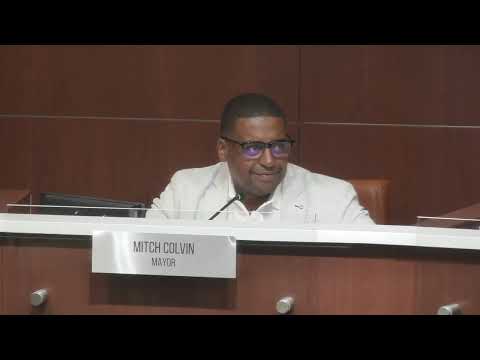
The mayor told the council the plan envisions a hybrid joint governance model: a governing board of 7–9 members appointed by the city and county to set policy and budget, and an operating board of public-safety professionals (police and fire chiefs, OCS director and other users) to set technical and operational standards. ‘‘Within 60 days of adoption of this resolution, the parties shall complete the ILA,’’ the mayor said, describing the timeline the council approved.
Under the model outlined by staff, the county would serve as the initial administrative unit responsible for receiving and applying for grants and executing payroll and procurement functions; the administrative role could rotate after an initial term (described in discussion as a possible five‑year rotation). The mayor and staff emphasized that the city’s investments — including training, accreditation, technology and real property — would be preserved and that ‘‘personnel parity items will be preserved and default to the highest standard,’’ the mayor said.
Council members pressed staff on details that remain unsettled. Councilman Hare said he remained uncomfortable with the process, calling it ‘‘a form of a hostile movement’’ and asked specifically how city employees’ pay and seniority would be protected during the transition. The mayor and staff responded that the work group and an independent integrator would define personnel protections and performance metrics, and that off‑ramps would exist if consolidation harmed service levels.
Officials discussed funding but did not finalize a method. Staff described a proposal under which the county would set a baseline payment covering services for all nine municipalities and the remaining net cost would be allocated by formula (examples mentioned included population or call volume), but the council was told the precise allocation and any percentages remain to be negotiated in the ILA.
Several council members raised accreditation concerns. Council member Jones noted local law‑enforcement and emergency service accreditations (referred to in the discussion as variants of ‘‘TriArc’’/accreditation) and asked whether consolidation would force a restart of accreditation processes; the mayor said the integrator and accrediting bodies would need to be consulted to preserve existing certifications.
The resolution also asks the North Carolina General Assembly to defer state intervention while local parties complete consolidation planning. The mayor said staff would return a joint resolution to the city’s legislative delegation before the stated deadline.
In a second motion the council also voted to keep the existing work group active and to require periodic reports to the council as the ILA is drafted and the integrator is selected. The council and staff characterized the coming 60 days as an aggressive schedule that will require several meetings of the work group to produce a draft interlocal agreement for both boards to consider.
Next steps: the city and county work group will engage an integrator, draft an interlocal agreement and return progress reports to the council within the 60‑day window; staff said the ILA will include details on governance composition, funding formulae, personnel protections and asset handling.
(Quotes and attributions are drawn from the council meeting transcript; where staff roles spoke but individual names were not consistently recorded in the transcript, reporting uses the speaker role.)