Get Full Government Meeting Transcripts, Videos, & Alerts Forever!
Get email alerts on the No Wrong Door topic
No spam. Unsubscribe anytime.
’No Wrong Door’ initiative aims to keep Washington County families from falling through service gaps
Summary
On Talk Justice, Washington County’s Family and Children 1st Council and Legal Aid of Southeast and Central Ohio described the No Wrong Door initiative: pocket resource guides, a secured listserv, court navigators and cross-agency training that link families to housing, benefits and legal help earlier.
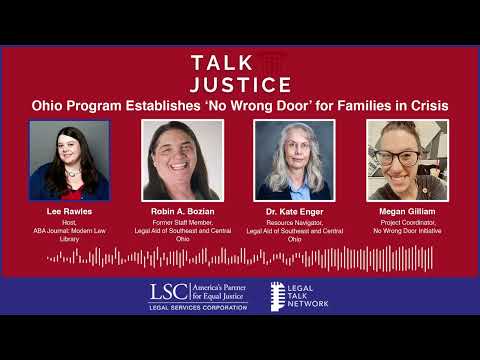
Lee Rawls, host of the Legal Services Corporation podcast Talk Justice, devoted an episode to Washington County, Ohio’s No Wrong Door initiative, a cross-agency effort designed to make it easier for families facing crises to find help.
The initiative, described by Megan Gillum, service coordinator and No Wrong Door project coordinator for the Washington County Family and Children 1st Council (FCFC), uses pocket resource guides, a secured listserv and recurring cross-systems trainings to ensure families are routed to the right services quickly. "No wrong door is very unique because it's not just about sharing resources. It's about getting an entire community to come together to ensure that no door is a wrong door when asking for help," Gillum said.
Why it matters: Guests said early identification and coordination can prevent problems from escalating into eviction, custody loss or homelessness. "Equal access to justice is a core American value," an announcer stated at the episode’s start, framing the conversation about how legal and social-service providers can respond more effectively to people in crisis.
Legal Aid and court navigation: Robin Bosian, a retired managing attorney who spent more than four decades at Legal Aid of Southeast and Central Ohio (LASCO), described LASCO’s broad rural practice—domestic relations, landlord-tenant work, public benefits and consumer matters—and emphasized outreach. Bosian said much of the legal response involves connecting clients to nonlegal supports: "The actual, quote, unquote, legal work is kind of maybe 30% or 40% of what you do." She added that getting clients to legal services earlier allows attorneys to solve problems before they worsen.
Intake and on-the-ground help: Kate Enger, a LASCO resource navigator based in Athens, described the Tenant Advocacy Project (TAP) clinics LASCO staffs in five counties where navigators perform intake and attorneys attend eviction hearings to protect tenant rights. Enger said navigators prepare paperwork, clear conflicts and follow up with clients when hearings are brief and attorneys must move quickly.
A common misperception corrected on air: Gillum shared that, before her work with FCFC, she believed "legal aid does not help with custody cases." During a clinic Robin Bosian encouraged her to apply to legal aid; LASCO accepted the case and an attorney secured a protection order and representation that changed the family’s trajectory. The episode highlights that eligibility and services can be broader than commonly assumed.
Tools and training: Gillum outlined No Wrong Door’s practical tools—pocket guides distributed to schools and partner agencies, a poverty-simulation exercise, monthly "social services 101" sessions and trauma-informed customer-service training—meant to improve referrals and the cultural competence of front-line staff.
Coordination network: Guests described a secured listserv that allows rapid, case-specific queries among partners including local mental health boards, health departments, the sheriff’s office and schools. Bosian and others gave examples of rapid problem-solving through the network, from utility assistance to finding school-sports equipment funding.
Advice for other communities: All three guests recommended replication: start small, invest in cross-agency training, create easily shared resource guides and cultivate informal referral relationships so partners 'know who to call' when a family needs help. "Instead of working against each other, we're referring to each other," Gillum said.
The episode closed with a reminder that the views expressed by guests were their own and that the podcast provides information, not legal advice. Listeners interested in implementing similar programs were directed to contact their local Family and Children 1st Council or comparable local coordinating bodies for guidance and partnership ideas.