Get Full Government Meeting Transcripts, Videos, & Alerts Forever!
Get email alerts on the People Over Parking Act topic
No spam. Unsubscribe anytime.
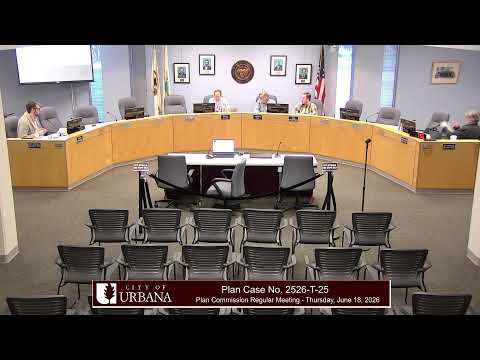
Urbana staff to amend zoning to comply with People Over Parking Act; commission forwards recommendation to council
Summary
Urbana planning staff presented a text amendment to add definitions from the People Over Parking Act to the city zoning code; the Plan Commission voted to forward the amendment to City Council with a recommendation of approval and scheduled introduction for July 6.
Planning staff told the Urbana Plan Commission they drafted a text amendment to align the city’s zoning ordinance with the state People Over Parking Act and asked the commission to forward the proposal to City Council. Staff said the law, which took effect June 1, prevents local governments from imposing minimum automobile parking requirements for development projects located within certain distances of frequent transit corridors or hubs.
The amendment would add the statute’s definitions into the zoning ordinance and include a map showing public transportation corridors and hubs. "The People Over Parking Act states that, except as otherwise provided, a unit of local government may not impose or enforce any minimum automobile parking requirements on a development project if the project is located within 1 half mile of a public transportation hub or 1 8th mile of a public transportation corridor," staff said in the presentation. Staff explained that the ordinance text would mirror the statute to ensure compliance and avoid introducing wording that could complicate implementation.
Why this matters: the change could remove local minimum parking requirements for parcels the state identifies as near frequent bus service, which staff said will be most extensive around campus because some routes run every 10 minutes. Staff emphasized the map was prepared using service levels that reflect the university semester and the August service rollout, and that the text amendment approach avoids the need to update an overlay district each time transit schedules change.
Commissioners raised implementation and equity concerns. One committee member said it feels "punitive to the people that live there" when the rule splits blocks so that one parcel requires parking and an adjacent parcel does not, and warned that frequent MTD route changes could create administrative burden. Staff replied the map was generated using peak service that runs most of the year and that the department can update the map internally if schedules change.
The commission also discussed statutory exceptions and asked staff to check definitional language for specific uses such as hotels; staff agreed to confirm that language before council consideration. Staff recommended forwarding plan case 25-25-T-26 to City Council with a recommendation of approval. A commissioner moved to forward the case "to the city council with a recommendation of approval, as written with no amendments," the motion was seconded, and the roll call showed affirmative votes; the motion passed.
What’s next: staff said the amendment would be introduced at the July 6 Committee of the Whole meeting, with final action expected July 13 if schedules hold.