Get Full Government Meeting Transcripts, Videos, & Alerts Forever!
Get email alerts on the Municipal Finance And Governance topic
No spam. Unsubscribe anytime.
Board approves consent agenda including $3.16M in warrants, ADU pilot and grant applications; moves to executive session on litigation
Summary
The East Hampton Town Board approved a consent/resolutions agenda that included a $3,158,415.94 warrant, authorization for ArcGIS maintenance, multiple hires, an ADU construction‑assistance pilot funded at $1,000,000 and authorization to seek up to $2,000,000 for Sammy’s Beach bulkhead work; the board then voted to enter executive session to discuss litigation.
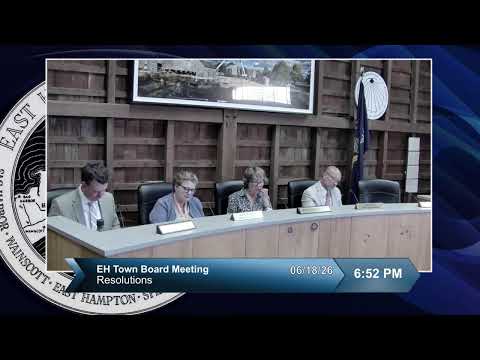
After public comment the East Hampton Town Board moved through a routine but extensive resolutions agenda and recorded approvals on a series of financial, personnel and program items.
The board approved warrant number 6b for $3,158,415.94 and a utility warrant of $39,487.35. It authorized ArcGIS maintenance for 2026 (ESRI) at a service cost of $1,056.36; approved multiple seasonal and full‑time appointments across aquaculture, parks and police departments; and authorized contracts and bid notices for equipment, fuel services and HVAC work.
Notable program and budget actions included adoption of an accessory dwelling unit (ADU) construction assistance pilot program, dated June 2026, with $1,000,000 budgeted from the Community Housing Fund to provide loans of up to $100,000 for ADU construction, and authorization to submit a New York State Consolidated Funding Application for Sammy’s Beach bulkhead replacement in an amount not to exceed $2,000,000.
The board also approved a release of a performance bond to Southfork Wind LLC in the amount of $571,567.46, authorized retention of outside counsel and approved several budget modifications across departments. Several rescissions of contracts of sale for specific properties were recorded on the consent agenda and were approved as read.
After completing the consent agenda, a board member moved, seconded and the board voted to enter executive session to discuss litigation matters. The public portion of the meeting concluded with the board in executive session.