Get Full Government Meeting Transcripts, Videos, & Alerts Forever!
Get email alerts on the Land Use topic
No spam. Unsubscribe anytime.
Minnetonka commission weighs limits and sustainability requirements for new drive‑thrus
Summary
After a staff sustainability review, commissioners considered four regulatory approaches — keep the current CUP path; limit drive‑thrus to select village centers; allow them with required sustainability offsets; or prohibit new drive‑thrus — and signaled prohibition is off the table as staff prepares a council update in July.
Planning staff and the city’s sustainability coordinator presented research on June 18 examining greenhouse‑gas impacts of vehicle idling at drive‑thrus and offered regulatory options as part of the city’s zoning ordinance update.
Ally Sutherland, the city’s sustainability coordinator, told the commission her analysis used regional trip‑generation data and vehicle idling fuel‑use charts to estimate emissions. She reported there are 27 drive‑thrus in Minnetonka and that idling at those facilities accounts for roughly 0.44% of the city’s communitywide greenhouse‑gas emissions, a small but measurable share.
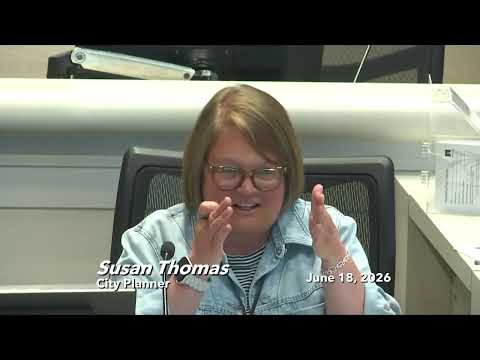
Miss Thomas and Sutherland laid out four options for the zoning update: (1) retain the status quo and allow drive‑thrus by conditional use permit (CUP) in village centers; (2) allow drive‑thrus only in particular auto‑oriented village centers; (3) allow them in select centers but require sustainability features or offsets as part of new construction; or (4) prohibit new drive‑thrus outright. The staff memo also suggested site‑level measures such as anti‑idling signage, ordering‑ahead technology, additional lanes, pedestrian windows and connections to transit or trails.
Commissioners debated trade‑offs between sustainability, pedestrian‑oriented design and economic development. Commissioner Johnson said he favored option 3 — allowing drive‑thrus in selected centers in exchange for sustainability measures and design tradeoffs. Commissioner Shoemaker said he leaned toward option 2, limiting locations to more auto‑oriented village centers. Commissioner Sher said she preferred allowing drive‑thrus across village centers provided sites were “right sized” with buffers and stacking requirements; several commissioners said a total ban (option 4) appeared unlikely.
The hearing included two public speakers: Luke Van Santen, a Ward 3 resident, urged that regulations allow servicing of all legal vehicles (for example trucks and other vehicle types), and Caleb Lee, a Chick‑fil‑A franchisee from the region, described his restaurant’s operations and economic contributions. Lee said his store’s operations were efficient — “we did 341 cars in 1 hour” during a recent count and averaged service times under three minutes — and urged the commission to allow high‑performing drive‑thru operators while considering design and mitigation requirements.
Staff recorded the commission’s feedback and said it would bring a summary to City Council in July; commissioners asked staff to consider hybrid approaches that pair geographic limits with design or sustainability requirements for new construction and to clarify how curbside pickup differs from drive‑thru land‑use impacts.
No formal regulations were adopted; staff will carry the commission’s input to the City Council as part of the zoning ordinance update process.