Get Full Government Meeting Transcripts, Videos, & Alerts Forever!
Get email alerts on the Comprehensive Plan topic
No spam. Unsubscribe anytime.
Goldsboro officials review draft 'Elevate Goldsboro' plan; direct staff to seek industrial-site input
Summary
Council and planning commissioners heard consultants summarize the draft Elevate Goldsboro comprehensive plan, including engagement metrics, guiding principles, place types and 72 recommended actions. Members discussed floodplain treatment and underutilized industrial sites and agreed to direct the manager to solicit WCDA and county planning input on industrial corridors.
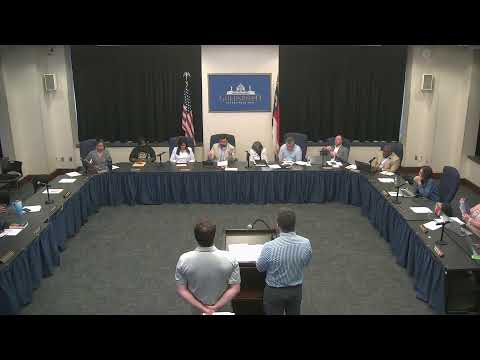
Goldsboro leaders and planning commissioners met in a joint session to review the draft Elevate Goldsboro comprehensive plan and discuss next steps in the adoption process.
Mayor Barratt opened the meeting by calling the session the culmination of about a year of work and noting the city’s goal to advance the plan through the planning commission this month and consider adoption at a council meeting in July. Mr. Livingston briefly introduced the item and turned the presentation to April Choice, the city’s Development Services Director.
Consultant Jonathan Whitehurst of Kimley Horn walked the board through the report’s structure and the team’s approach. He described the document as “a living document” and said the plan is organized around a vision and five guiding principles—engage, grow, move, prosper and thrive—supported by a future land-use map and a policy framework that contains 20 strategies and 72 actions. “We had 650 touch points, more than 5,000 individual data points, nearly 1,000 written comments and 560-plus community hours,” Whitehurst said, citing the engagement that informed the draft.
The consultants explained that the future land-use map refines the study area to the city and nearby areas and breaks the map into 14 place types (from rural residential to downtown transition zones). They said that, although the existing land-use acreage shows a large share of single-family residential in the broader study area, the future map shifts more acres toward mixed-use and commercial corridors so that residential would make up slightly more than half of the mapped area in the future.
Council and planning commissioners focused questions on where to find implementation priorities (the consultants pointed to the implementation matrix and community-priority markers in the action matrix), on differences between existing and future land-use percentages, and on how the plan treats flood-prone areas. On floodplain policy, consultants and staff said the plan uses a conservation place type and flags special districts; they also discussed prior FEMA buyout parcels enrolled with the state recovery program and the trade-offs between buyouts and other responses such as elevated construction.
Members pressed the consultants about underutilized industrial properties and whether industrial development should be pushed toward interstate corridors. Staff and the consultants said practical constraints—ingress/egress, available utilities and site configuration—often determine whether a parcel is suitable for industrial use. One participant asked for WCDA and county planning input on industrial opportunities and constraints along the interstate corridors.
Mayor Barratt asked whether there was any objection to directing the city manager to get input from “WCDA and county planning specifically as it relates to industrial property along the interstate corridors.” Hearing no objections, the council and commission reached consensus to have staff solicit that input and report back to planning commission and council as the plan moves forward.
The meeting closed with a reminder that planning commission will consider forwarding the plan later this month and that council will take up any recommended changes; leaders said they would not rush adoption if the document needs further work. A motion to adjourn passed unanimously.
What’s next: planning commission review later this month, staff to gather WCDA and county planning feedback on industrial corridors, and council consideration of the plan (tentatively in July, with timing subject to change).