Get Full Government Meeting Transcripts, Videos, & Alerts Forever!
Get email alerts on the Wildfire Preparedness topic
No spam. Unsubscribe anytime.
Curry County fire chiefs, state marshal outline mutual-aid steps ahead of fire season
Summary
Gold Beach Fire Chief Tyson Krieger and Oregon State Fire Marshal regional mobilization coordinator Mike Cook briefed Curry County commissioners on the state mutual-aid system, prepositioning, immediate response protocols and reimbursement timelines as fire season ramps up.
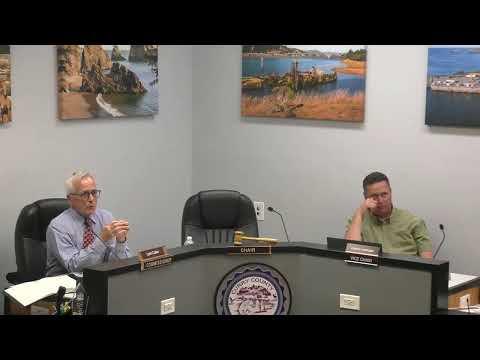
Gold Beach Fire Chief Tyson Krieger and Oregon State Fire Marshal staff told Curry County commissioners at a 2026 workshop that interagency mutual aid and pre-season coordination are central to limiting property and life loss this fire season.
Tyson Krieger, Gold Beach fire chief and Fire Defense Board chief for Curry County, said the county’s various fire agencies each have distinct responsibilities and that the Fire Defense Board helps coordinate who does what during an incident. "Everybody in this room has a different obligation to a different batch of ground," Krieger said, explaining the board’s role in clarifying responsibilities and in relaying information to the commissioners.
Mike Cook, regional mobilization coordinator for the Oregon State Fire Marshal, walked commissioners through the Oregon Fire Mutual Aid System—local departments first, then neighboring departments, then county fire defense board coordination and, if overwhelmed, state resources and EMAC (Emergency Management Assistance Compact) deployment. Cook described three operational steps: prepositioning (moving resources ahead of anticipated weather), immediate response (short-term reinforcements to keep events from expanding) and a conflagration declaration that requires the governor’s signature for larger mobilizations.
Cook offered typical timelines and fiscal notes: prepositioning is often arranged 72 hours before an expected event and is reimbursable (per diem paid by the state); immediate-response teams can be assembled rapidly; a conflagration request can be approved within 15–30 minutes of submission but may take 60–120 minutes or longer to get crews on the road depending on origin. He said the State Fire Marshal’s incident management teams (IMTs) are available when local resources are exhausted. "If the fire defense board chief gets to me as soon enough, we can usually get that up and back between 15 and 30 minutes," Cook said of initiating the conflagration process.
Speakers emphasized the value of local knowledge in anticipating wind and terrain effects, and commissioners praised the county’s South Coast coordination during last year’s Moon Complex response. Cook noted practical logistics—communications plans, maps and radios (he carries a cache of 30 programmable radios) —and urged that local crews prepare to be self-sufficient for about 72 hours while state resources are mobilized.
Commissioners and presenters also discussed communications redundancy. Lynn (the commissioner presiding over the transient waste portion of the workshop) and Cook said CERT and amateur (ham) radio operators provide backup communications, and local emergency managers will be integral to staging and relaying resource requests.
The workshop closed the preparedness segment with commissioners designating a liaison to receive incident updates, and presenters outlined next steps for continued interagency coordination and preparedness exercises.
The commissioners recessed before starting a separate workshop on transient waste and highway right-of-way cleanup.