Get Full Government Meeting Transcripts, Videos, & Alerts Forever!
Get email alerts on the Public Safety topic
No spam. Unsubscribe anytime.
Mexico Public Safety chief cites lower NIBRS crime counts, higher dispatch workload and staffing shortfall
Summary
Chief Bryce Mesko told the council the department handled about 12,580 calls for service and 28,561 dispatch actions in 2025, reported lower NIBRS crime totals and higher clearance rates, and warned staffing remains seven positions short as DWI arrests rose by half.
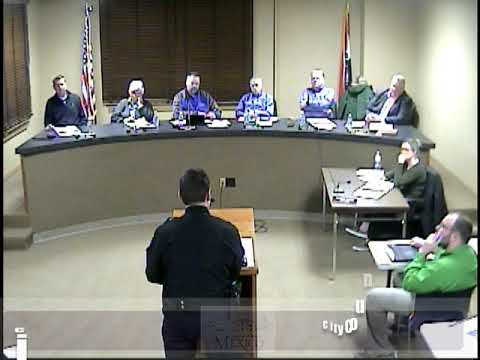
Chief Bryce Mesko told the City Council that Mexico Public Safety handled about 12,580 calls for service in 2025 and recorded 28,561 dispatch actions, figures he said better capture the department’s workload than calls alone.
"We did about 12,580 calls for service in 2025," Mesko said, adding that the larger dispatch count includes traffic stops and self-initiated investigations. He said the department’s National Incident-Based Reporting System figures fell in 2025 and that clearance rates for certain crimes — burglaries cited at roughly 44% — remain above national averages.
Mesko highlighted specific operational data: roughly 1,542 traffic stops (a 13% increase from 2024); 268 people booked in 2025; about 985 cases forwarded to prosecutors; 242 fire calls; and roughly 1,933 ambulance or first-responder assists. He said thefts decreased markedly and that a series of incidents involving juveniles from other towns produced investigations and prosecutorial referrals.
The chief said traffic crashes have declined from earlier years but that fatalities remain a stubborn challenge, driven recently by impaired or aggressive driving. "In 2025, we did 30 arrests for DWI," he said, noting that figure is about 50% higher than in 2024.
Mesko described training and partnership work the department pursues: participation in the East Central Drug Task Force, contributions to regional training at a Boone County center, and an integrated Crisis Intervention Training approach. He singled out Major Thompson as a Drug Recognition Expert assisting the Law Enforcement Training Institute.
On personnel, Mesko said the department has struggled to recruit and retain staff: "We hired 4 and lost 5" in 2025, and the department was about seven positions short by early 2026. He identified pay and broader labor-market shortages as contributing factors and said the city is conducting a compensation study.
Council members asked clarifying questions about the department’s intermediate force tools and recruiting. In response to a question about the so-called OPN tool, Mesko described it as a type of nunchaku designed primarily for control.
Mesko closed by noting recent examples of successful responses — including an October house fire in which crews rescued a woman and child — and urging continued focus on hiring and training as the most pressing issue in 2026.
Next steps: staff said they will continue recruitment efforts and follow up with the council on compensation-study results and any recommended staffing changes.