Get Full Government Meeting Transcripts, Videos, & Alerts Forever!
Get email alerts on the Transportation Infrastructure topic
No spam. Unsubscribe anytime.
Wheat Ridge council backs targeted outreach for $10 million 38th Avenue ‘refresh’
Summary
Wheat Ridge staff presented two design alternatives for a $10,000,000 38th Avenue refresh funded by the city’s 2J sales tax; council gave consensus to pursue targeted business outreach and a 30% concept design before returning with a recommended option.
Wheat Ridge City officials on June 15 advanced concepts for a $10,000,000 refresh of 38th Avenue and agreed to begin targeted outreach with businesses and property owners before selecting a preferred design. Director Lauren Michalak told council the work is a ‘‘refresh,’’ not a full reconstruction, and is funded by the city’s 2J sales tax extension.
The project team presented two corridor-wide approaches. Public Works Director Kent Kissman said Alternative A keeps much of the existing flow line and on-street bike lanes, while Alternative B shifts the flow line to enable an eight-foot multimodal path, wider and more consistent sidewalks, increased tree canopy and additional parking near the green. ‘‘Alternative B gives us a stronger place‑making identity but comes with higher construction complexity,’’ Kissman said. Michalak emphasized the concepts are ‘‘conversation starters’’ and not final designs.
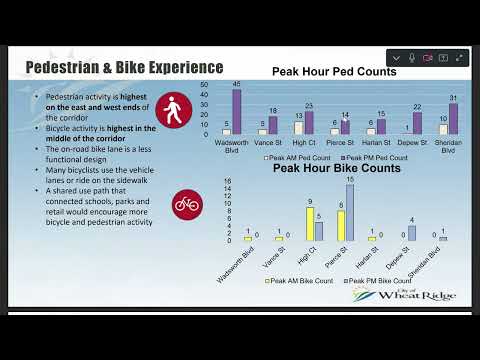
The presentation also flagged school‑area safety work already funded by grant: staff said a HAWK signal near Stevenson Elementary is in hand and both alternatives would incorporate an improved crosswalk, painted crossbox and a pedestrian refuge or median to slow traffic and improve crossings. Kissman said the multimodal path would connect schools, parks and retail and improve pedestrian comfort and ADA continuity in the Main Street core.
Resident Guy Namiasch, speaking during public comment, urged caution about construction timing. ‘‘When I see a red cone or an orange cone, I freak out,’’ Namiasch said, adding business owners are just starting to recover after years of work on Wadsworth and warned that prolonged construction could depress voter support for upcoming funding asks.
Councilors focused questions on tradeoffs: lane widths and RTD bus clearances, where councilor Hoehm said 10-foot‑6 lanes seemed acceptable if buses could operate; councilor Martel asked whether concepts fit the roughly $10,000,000 allocation, and staff replied the alternatives are generally within that budget at the concept level. Staff projected a public engagement push in late summer or early fall, a 30% design by year’s end, advertising for final design in 2027 and potential phased construction beginning in 2028.
Engagement Coordinator Ashley Holland outlined a phased outreach strategy that prioritizes one‑on‑one meetings with businesses and property owners likely to be most affected, along with online materials and lighter open engagement for the broader public. Staff said they would avoid corridor‑wide simultaneous construction by staging work in phases.
Councilors also raised technical questions about flow‑line changes, storm drainage, ADA continuity and whether certain curb moves would require ordinance action. Staff noted that moving a flow line or changing the street width would be an ordinance decision and could, like any ordinance, be subject to a referendum.
The council signaled consensus to send the concepts to the targeted outreach described by staff. Next steps: staff will refine the alternatives based on business and property‑owner feedback, return with a narrowed 30% concept, and then seek council direction for final design and construction phasing.