Get Full Government Meeting Transcripts, Videos, & Alerts Forever!
Get email alerts on the Water Infrastructure topic
No spam. Unsubscribe anytime.
Public Water District outlines 2nd Avenue waterline upgrade; city warned extra work may be needed for fire protection
Summary
Presenters for Public Water Supply District No. 12 told the Greenwood Board the district will bid a 6-inch base replacement for a 4-inch line on 2nd Avenue with an 8-inch alternate; engineers said an 8-inch line would be needed to reach roughly 1,000 gallons per minute for fire flow, but upstream 4-inch/2-inch mains and pressure loss mean the city may need to pay for additional upgrades.
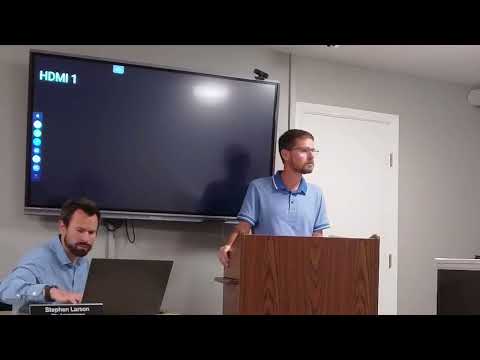
Chad Harrington, a representative of Public Water Supply District No. 12, told the Greenwood Board of Aldermen that the district plans to replace an existing 4-inch water main on 2nd Avenue with a 6-inch base line and an 8-inch alternate to keep the new water main out from under recently rebuilt pavement.
Harrington said the district will bid both sizes and that the 8-inch option is the only realistic route to achieve about 1,000 gallons per minute of fire flow to the far end of 2nd Avenue. "If it is desired for fire protection down 2nd Avenue in the future, that line would need to be 8 inch," he said.
Why it matters: the district’s funding and DNR approvals cover potable-water replacement but do not obligate the district to provide fire protection. Vicki McLaughlin, also representing the district, told alderpersons that because the district secured plan approval from the Department of Natural Resources the board approved construction of a 6-inch main; the incremental cost to install an 8-inch main would fall to the city unless the city chooses to assist now.
Board members pressed presenters on hydraulic details and trade-offs. Harrington and McLaughlin warned that replacing the 4-inch feeder mains that currently supply the 2nd Avenue run — and frictional pressure loss across long distances — could still cause pressure drops below thresholds necessary for hydrant service even if a short 8-inch segment is installed. "You’re gonna need to run an 8 inch from the 12 inch at least partially down 2nd Street," Harrington said, noting there is nearly a mile of 4-inch main in place.
Staff said plans are DNR-approved and that two easements remain before the district can put the project to bid; Harrington estimated some preliminary costs for parts of the work at "maybe $20,000 to $30,000" and said he would provide an updated cost breakdown and hydraulic-model outputs to the city and the district’s engineer for review.
What the board can expect next: the district will move toward bidding once easements are secured; city engineering and district staff will exchange hydraulic modeling so the board can decide whether to pay the incremental cost now to install 8-inch piping or phase upgrades over time. No formal change to the project scope or budget was approved at the meeting; the presentation closed with an agreement for staff to provide detailed cost and hydraulic information.
The board discussed the item as part of regular agenda business and did not vote on a formal commitment to fund an 8-inch upgrade at this meeting.