Get Full Government Meeting Transcripts, Videos, & Alerts Forever!
Get email alerts on the Landfill Expansion topic
No spam. Unsubscribe anytime.
Commission approves Part 1 permit submission to start landfill expansion review; borrow‑pit, soils and leachate work remain
Summary
The Loudoun County Solid Waste Commission voted to approve a Part 1 permit submission to begin the formal permitting timeline for a horizontal landfill expansion and discussed borrow‑pit access, possible salvage of trees, use of 2,000 tons of ADC soil from Morgan County pending testing, and delays to a new leachate tank amid soil shortages.
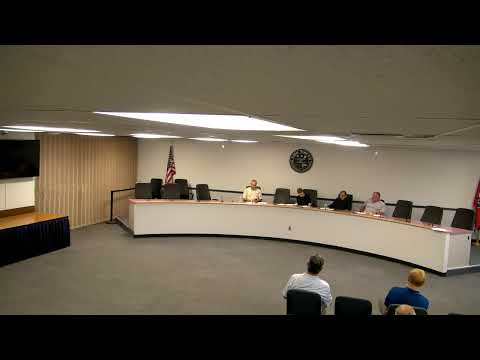
The Loudoun County Solid Waste Commission voted during its May 20, 2026 meeting to approve a Part 1 permit submission that begins the formal one‑year permitting clock for a proposed horizontal expansion of the county landfill.
Stoddard, the presenter for the permittee, told commissioners that Part 1 ‘‘just details the property or the expansion limits that identifies the buffers and kind of just identifies the location regionally of the landfill’’ and that the geotechnical and hydrological analyses that underpin final approval are typically included in Part 2. He said, ‘‘the part 1 application starts that clock. So we effectively have a calendar year, to get this fully approved.’’
The commission also approved a borrow‑pit plan intended to provide intermediate cover and topsoil for the capping project. Stoddard said access will be from the south and ‘‘any stream intersection is not going to occur,’’ describing a combination of perimeter ditches, erosion controls and other best‑management practices (BMPs) intended to prevent sediment leaving the site. He said long‑term reclamation measures — slope stability, vegetation and periodic maintenance — are included in the plan and, once permitted, ‘‘the permit just doesn't go away.’’
Republic operations staff gave a broader operations and engineering update. They reported modules 1 and 2 are floored and that a new SCADA telemetry system now allows remote monitoring of leachate sump levels. Republic said they have increased clean‑out cadence and expect capping work to continue; however, staff repeatedly cautioned that intermediate cover and topsoil shortages are constraining some work.
Commissioners discussed tree removal and potential salvage. Stoddard said crews can cut trees and stage lumber for local woodworkers but noted logistics, insurance and procurement rules complicate simply ‘‘giving it away.’’ He added that leftover material could be used as firewood if not otherwise milled or brokered.
An offer to bring in roughly 2,000 tons of soil from Morgan County as alternative daily cover (ADC) drew detailed questioning. A Republic speaker said the material might be available at an ‘‘advantage price’’ of about $25 per ton but emphasized that acceptance would require laboratory analyses and approvals from both the Tennessee Department of Environment and Conservation (TDEC) and Republic’s special waste group. Stoddard described the intended use as intermediate cover that would be overlain by compacted soil and geosynthetics; commissioners recorded that they would not approve the material at the meeting and asked staff to provide analytical results before the next decision.
Other operational items discussed included a planned bat mist‑netting survey (to evaluate summer bat activity and inform timing for clearing), a new leachate tank project requiring grading and soil to site two 250,000‑gallon tanks, and ongoing sampling for groundwater and turbidity. Stoddard noted that Pond 2 has been dewatered and staff are evaluating ways to stabilize very soft soils at some locations.
The Part 1 submission was advanced with a motion and recorded as carried. Commissioners and staff said Part 2 — with the technical analyses and a more detailed schedule — is likely to follow later this year once permitting and data are complete.
What comes next: staff said they will complete outstanding map and permit pages, provide requested analytical reports on the Morgan County soil offer, and coordinate with procurement and TDEC on next steps for the borrow‑pit access, bat survey timing and the leachate tank schedule.