Get Full Government Meeting Transcripts, Videos, & Alerts Forever!
Get email alerts on the HIV AIDS topic
No spam. Unsubscribe anytime.
UNAIDS executive director warns funding cuts, rights rollbacks threaten AIDS response
Summary
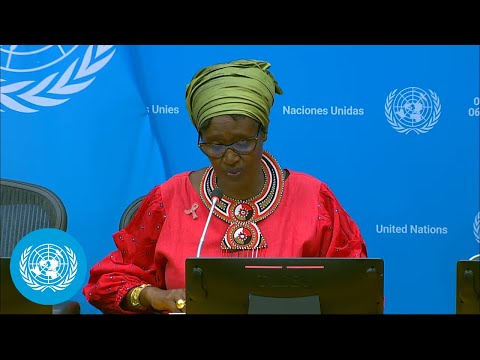
Winnie Banyema, executive director of UN AIDS, told reporters the General Assembly's high-level meeting must deliver an ambitious political declaration, sustained international financing and protections for the rights of people living with HIV, warning recent ODA declines and rights rollbacks risk reversing progress.
United Nations Executive Director Winnie Banyema warned reporters that recent, rapid cuts in international development assistance and growing rollbacks of rights are threatening global progress against HIV/AIDS and urged member states to sign an ambitious political declaration at the General Assembly high-level meeting.
Banyema said the meeting, the fifth high-level UN session on AIDS since the first special session 25 years ago, should set ambitious five-year targets and recommit multilateral resources and coordination. "Multilateralism is at its weakest today. This is a great story of the success of multilateralism," she said, and asked governments to "assert that multilateralism is alive and well by passing an ambitious declaration."
She outlined three central priorities she wants embedded in the political declaration: commitments to multilateralism and ambitious targets for the next five years; sustained international financing while countries scale up domestic resources; and protections for the human rights of people living with HIV and key populations so community-led services can operate. "Do not take money away because you're taking lives away," Banyema said, calling for a planned transition as external assistance declines.
Banyema cited data she attributed to UNAIDS showing significant treatment coverage but remaining gaps: she said about 32.1 million of roughly 40 million people living with HIV are on lifesaving treatment, while about 9 million remain untreated and, she said, roughly 1.2 million people were newly infected last year (figures as stated by the speaker). She also cited an OECD finding (as she described it) that official development assistance fell by 23% in 2025, a sudden decline she said is hitting high-burden, low-income countries hardest.
On human rights, Banyema warned of a disturbing reversal in some places where decriminalization has stalled and some countries enacted harsher laws targeting same-sex relationships. She listed populations she said face particular risk if rights are not respected: gay men and other men who have sex with men, transgender people, people who inject drugs, sex workers and prisoners, and argued that protecting civic space for communities is central to delivering services.
During a question-and-answer session, Banyema said 52 countries increased domestic financing for HIV last year and that many are integrating HIV services into broader health systems to achieve efficiencies, but that domestic increases do not fully fill the gap left by declining external assistance. Asked about the United States's reported phased withdrawal of PEPFAR funding from South Africa, she described the decision as "sad," noting South Africa's large HIV burden and saying the U.S. bilateral program historically played a major role in global funding.
On changes inside the UN system, Banyema described UNAIDS as a joint program of 11 UN entities and said a working group is designing a plan to consolidate the secretariat and pass some functions to co-sponsors such as WHO, UNICEF and UN Women; she said the board is expected to adopt a transition plan by October, with implementation beginning next year, and that a smaller hub would remain to provide leadership and coordination.
When a reporter asked whether UNAIDS has an estimate of additional infections or deaths that could result from ongoing funding cuts, Banyema said long-term estimates are not yet available but pointed to early warning signs: she said HIV testing in high-burden countries has fallen by about 22% and that condom distribution has dropped by as much as 90% in some places, trends she warned could lead to increased new infections in subsequent years.
The briefing concluded with the moderator thanking Banyema and her offer to take questions; Banyema urged member states to sustain international financing, fully fund the Global Fund and protect rights and civic space to prevent reversals in progress.