Get Full Government Meeting Transcripts, Videos, & Alerts Forever!
Get email alerts on the Grant Competition topic
No spam. Unsubscribe anytime.
U.S. Department of Education outlines 2026 grant competition for National Center on Improving Literacy for Students with Disabilities
Summary
The U.S. Department of Education held a pre-application webinar detailing priorities, eligibility, selection criteria, deadline (June 30, 2026), and estimated funding (~$1.5 million for year one) for the 2026 National Center on Improving Literacy for Students with Disabilities grant competition.
Dr. Michelle Daley, group leader for the Comprehensive Centers program in the Office of Program and Grantee Support Services at the U.S. Department of Education, led a webinar that reviewed application requirements, priorities, and review criteria for the 2026 National Center on Improving Literacy for Students with Disabilities competition.
The department is accepting applications through June 30, 2026, for a competition that may fund a national comprehensive center, regional centers, and content centers, including the National Center on Improving Literacy for Students with Disabilities (NCIL). "The department is accepting applications through 06/30/2026," Daley said, and she directed applicants to the ANI on Grants.gov (Funding Opportunity: Edgrants-fiveeleven20; ALN 84.283D) for the official instructions.
Why it matters: NCIL is authorized under the Elementary and Secondary Education Act, as reauthorized by the Every Student Succeeds Act of 2015, to develop and identify evidence-based literacy assessment tools, professional development, instructional strategies and accommodations for students with disabilities. The center is intended to produce accessible screening tools for early identification (no later than kindergarten), support evidence-based instructional approaches and assistive technology, and provide families and educators with usable resources.
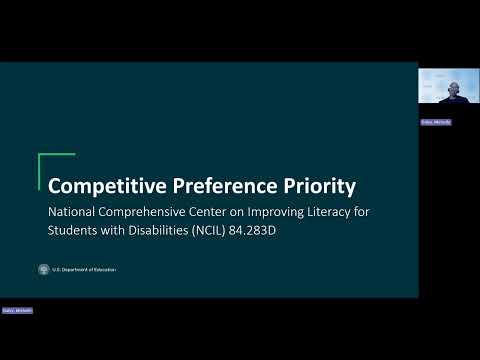
Priorities and points: The competition features one absolute priority—to establish and operate a national center focused on literacy for students with disabilities—and one Competitive Preference Priority ("returning education to the states") worth up to 10 points for applications that include state endorsement or are carried out by state educational agencies or approved designees. Daley said applicants should include clear evidence of endorsement (for example, a letter on official letterhead) at the time of submission to qualify for those points.
Application requirements and review criteria: Applicants must submit a standalone application for each center they pursue. The ANI sets seven general application requirements for all centers and additional requirements specific to content centers. Narratives must address capacity-building approaches, logic models, qualifications of key personnel, partnership commitments, performance-measure systems, and a budget narrative showing cost effectiveness. Reviewer scoring for NCIL totals up to 100 points across three criteria: significance (up to 15 points), quality of project design (up to 55 points), and quality of management plan (up to 30 points). Daley listed subfactors reviewers will use, including the strength of data and evidence, feasibility of the management plan, staffing qualifications, and budget adequacy.
Program expectations and partnerships: Centers are expected to coordinate closely with the CC Network and Regional Education Laboratories (RELs) to disseminate products nationally and to partner with state and local education agencies. Grantees must document client engagement in annual service plans and formal partnership agreements and must participate in the department's required national evaluation of the Comprehensive Centers program.
Funding and timelines: Daley said Congress appropriated approximately $50 million for the Comprehensive Centers program in FY2026, with roughly $1.5 million estimated for the NCIL award. The department estimated the first budget period funding for NCIL at approximately $1,485,000–$1,500,000 for the first 12-month budget period of a project up to 60 months; funding for subsequent budget periods depends on future appropriations.
What applicants should do next: Review the ANI posted on Grants.gov (Edgrants-fiveeleven20; ALN 84.283D), follow the application-package instructions in the ANI, include required documentation such as letters of state endorsement if claiming CPP points, and ensure the budget narrative includes the required 5% annual set-aside for emerging needs. Daley closed by thanking attendees and pointing them to recorded resources and the Comprehensive Centers program webpage for additional guidance.
The department's ANI and the Grants.gov posting are the official sources for application requirements and submission procedures.