Get Full Government Meeting Transcripts, Videos, & Alerts Forever!
Get email alerts on the State Legislation topic
No spam. Unsubscribe anytime.
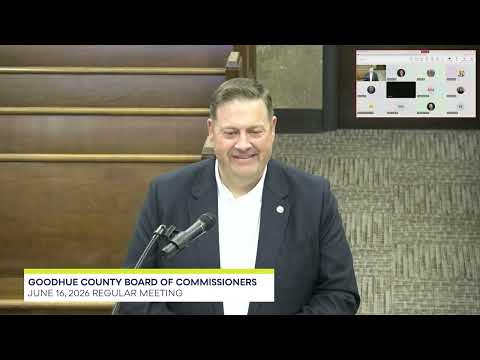
State Rep. Keith Allen briefs Goodhue County on DHS modernization, bonding and school-bus safety
Summary
State Rep. Keith Allen updated the Goodhue County Board on 2026 legislative outcomes, highlighting an Office of the Inspector General for fraud, funding for DHS technology modernization, $12 million in local bonding for the Zumbro wastewater project and a change making school-bus stop enforcement depend on flashing red lights. Commissioners pressed for more proactive fraud prevention.
State Representative Keith Allen told the Goodhue County Board on Tuesday that lawmakers addressed long-standing problems in state programs this session, including fraud oversight, DHS technology modernization and infrastructure funding.
"It's independent of the house. It's independent of the governor's office," Allen said of the newly created office of the inspector general, which he described as having "teeth to go after a lot of the fraud that we've seen in the state of Minnesota." He credited county advocacy at the Capitol for shaping lawmakers' attention to local tax and service concerns.
Allen said the Legislature secured funding for DHS technology modernization and for capital projects statewide, noting approximately $1.2 billion in bonding statewide and a roughly $12 million allocation into the bonding bill that will support the Zumbro Wastewater Treatment Plant project serving Prairie Island, Zumbrota, Wanamingo and Goodhue.
"We were able to get a total of, I think, $12,000,000 back into the bonding," Allen said, adding that the money should keep that local project viable rather than on life support.
Commissioners raised questions about whether new oversight measures would be proactive enough to prevent fraud, rather than merely reactive. Commissioner Anderson asked if the new laws included preventive tools or only stronger recovery mechanisms.
Allen pointed to whistleblower protections and direct reporting mechanisms established with the OIG as a key proactive element. "They can report it directly over to them and try to get that going forward," he said, adding that staff on the ground often detect problems early and that whistleblower protections should help surface those issues sooner.
On public-safety legislation, Allen described a clarification to school-bus laws that will base enforcement on whether red lights are flashing rather than the mechanical deployment of stop arms. "So instead of it being hinged on the stop arm coming out, it's all based on whether or not the red lights are flashing," he said, adding the change gives enforcement more clarity and enforceability.
Why it matters: the board said the session's work responds to locally felt issues — from property-tax pressures to the operational problems that county staff and local hospitals have reported — and sought assurances that state-level fixes will produce practical, enforceable change. Allen told commissioners he would continue pursuing statutes and funding that give counties clearer authorities and better tools for oversight.
Next steps: Allen left time for questions and said he would continue working with county officials on legislative fixes and funding priorities.