Get Full Government Meeting Transcripts, Videos, & Alerts Forever!
Get email alerts on the HB986 Deepfakes topic
No spam. Unsubscribe anytime.
Representative Thomas pushes felony for election deepfakes, committee debates scope and enforcement
Summary
Representative Thomas introduced a substitute to HB 986 (LC560069S) to criminalize malicious deepfakes used to influence elections within 90 days of voting. Committee members raised First Amendment concerns, suggested disclosure rules, private injunctive remedies and questioned enforcement by the State Elections Board.
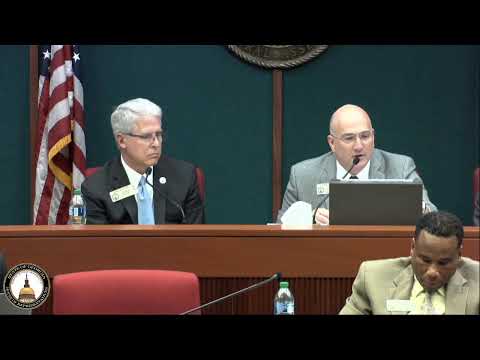
Representative Thomas presented a substitute to House Bill 986 (LC560069S) at a joint work session on AI policy, proposing to make creating, publishing or distributing a deceptive “deepfake” within 90 days of an election a felony if done with intent to deceive one or more electors.
The bill defines a deepfake and narrows the class of people covered by the statute (lines 33–35), exempts deepfakes created by or at the request of a candidate, and sets punishment for a conviction at one to five years of imprisonment and a fine not to exceed $50,000. Thomas described the measure as an early, narrowly tailored step to address "nefarious uses" of generative AI in campaigns while preserving legitimate uses of the technology.
Committee members pressed the sponsor on several recurring concerns. Representative Kendrick asked whether the language—phrases such as "reducing the candidate's chance"—would miss content that instead increases a candidate's standing; another member proposed replacing "reducing" with "changing" to capture both directions. Thomas said the draft intentionally limits coverage to actors who meet the bill’s definition of "person" (campaign staff, volunteers or similarly affiliated individuals), and that material by unaffiliated private supporters likely would not be covered.
Chairman Gunter and others cautioned about First Amendment limits. Gunter said narrowing to specific, false accusations (for example, falsely accusing a candidate of criminal or immoral conduct) or acts that prevent voters from voting would be more likely to survive constitutional review. "Falsely accuse a candidate of any criminal or immoral conduct" was discussed as potentially more workable than broader influence language.
Several legislators urged faster civil remedies in addition to—or instead of—felony penalties. Representative Holcomb told the committee he would like to "consider and explore whether or not it makes sense to have some type of private right of action, specifically an injunction," arguing that injunctions could remove harmful material faster than criminal prosecutions. Representative Reeves and others pointed to disclosure regimes used in other states—labels or warnings on AI-generated campaign material—as a less speech-restrictive transparency tool.
Members also debated enforcement mechanics. Thomas said legislative counsel recommended giving the State Elections Board investigatory authority for alleged violations but acknowledged concerns that the board lacks investigatory resources and that routing many claims through an elections board could be "weaponized." Several members asked whether law enforcement (peace officers or prosecuting attorneys) or the GBI would be involved in criminal investigations and urged coordination with DA offices to sharpen the elements of the proposed offense.
Other technical questions included whether the statute should cover distribution methods beyond "broadcasts, streams and uploads" (one member suggested adding "distribute") and whether the 90‑day pre‑election window is the right cutoff; Thomas said the 90‑day period tracks consistency with other states but is amenable to revision. Members also urged that the substitute’s definition of "person" be revisited so as not to create a loophole that exempts third‑party bad actors.
The committee did not vote. The sponsors said they will revise language—considering narrower falsity-based elements, disclosure requirements and civil injunctive processes—and to consult with prosecutors and elections experts before reconvening. The session moved on to a separate state-level AI bill after the discussion.