Get Full Government Meeting Transcripts, Videos, & Alerts Forever!
Get email alerts on the Municipal Budget topic
No spam. Unsubscribe anytime.
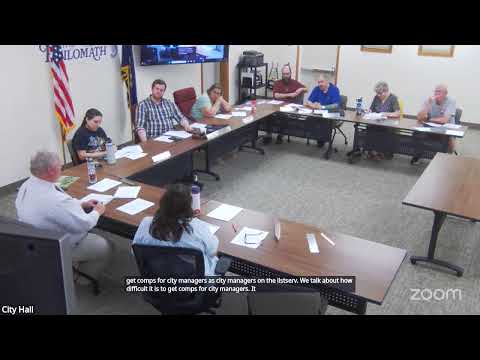
Philomath adopts 2026–27 budget after heated debate over $5 public‑safety fee
Summary
The Philomath City Council adopted the FY 2026–27 budget 6–1 on June 22, 2026 after extensive debate over a proposed monthly city services (public‑safety) fee. Council directed staff to draft a $5 fee ordinance with a low‑income reduction; a motion to raise the fee to $6 failed 4–3.
PHILOMATH, Ore. — The Philomath City Council adopted its fiscal year 2026–27 budget on Monday evening by a 6–1 vote, after several hours of deliberation about service cuts, event funding and a proposed monthly city services fee intended primarily to support police salaries.
Mayor Christopher McMoran opened the meeting at 7:15 p.m. and described a packed agenda before the council, which ultimately passed Resolution 26‑19 to adopt the budget and make appropriations for the coming year.
The budget presented by staff included a roughly $34 million set of requirements, a projected reserve and assumed revenue from a possible city services fee. Finance staff told the council that state shared revenues are down slightly and that system development charge receipts for the North 11th/12th Street project raised beginning fund balances for certain capital funds.
Why it matters: Councilors said the budget reflects difficult tradeoffs between preserving services and holding the line on residents’ costs. Many councilors stressed the need to preserve core public-safety and public‑works functions while trimming less-essential expenditures.
Key points and debate
- Event funding and local projects: Councilors and staff discussed cuts made by the Budget Review Committee to discretionary items, including the proposed “Bridal on 13th” event. Staff warned that the committee eliminated that line item; without restored funding the event would likely be canceled this year. Councilors said they preferred to pause the new event and revisit it next year rather than reallocate scarce funds now.
- Fee to support police pay: A central point of contention was a proposed monthly fee intended to shore up police pay so the city remains competitive. City Manager Chris recommended naming the revenue source to make its purpose clear: “My just recommendation…would be to call it what it is supporting, which at this point is public safety and the police department,” he said.
Council considered a staff proposal that assumed a $5 per month fee in the adopted budget and included a proposal to reduce or waive the charge for qualifying low‑income households. Councilor Jessica Andrade pressed for caution around cuts and pay priorities: “I do think we should cut from the police budget, and I do think $4,000 is an extremely reasonable ask,” she said during deliberations.
- Last‑minute amendment fails: Councilor Crocker moved, and Councilor Nielsen seconded, an amendment instructing staff to prepare an ordinance with a $6 monthly fee (and a reduced low‑income rate). The amendment failed 4–3. After that vote, council directed staff to return in July with an ordinance reflecting the direction given in council discussion — staff said they would draft a $5 fee ordinance with a 50% low‑income reduction or a waiver option and could include an emergency clause to accelerate implementation if the council desires.
Outcome and next steps
Council adopted the FY 2026–27 budget by voice vote, 6–1. The council’s direction to staff is to prepare an ordinance for the fee (staff said they will bring the draft back at a July meeting), and to continue implementing capital improvements funded through urban renewal (lighting and a pavilion) regardless of event cancellations.
The council also adopted several related resolutions on Monday (tax rate, state shared revenue election, supplemental budget) and asked staff to return with precise fee ordinance language, low‑income criteria and the timeline for implementation.
What’s next: Staff will draft an ordinance for the council to consider in July that implements the fee and describes any low‑income reduction; the council may add an emergency clause to make the fee effective sooner if it so chooses.