Get Full Government Meeting Transcripts, Videos, & Alerts Forever!
Get email alerts on the Water Infrastructure topic
No spam. Unsubscribe anytime.
Richmond Water and Sewer Commission says three easements secured for Tilden Avenue waterline project; commissioners weigh curb-stop installs to save future cost
Summary
The Richmond Water and Sewer Commission reported three signed easements for the Tilden Avenue/Bridal Street/Cochran Road waterline replacement and debated installing curb stops now — staff said curb stops cost about $300 and that installing them during construction could spare homeowners higher costs later.
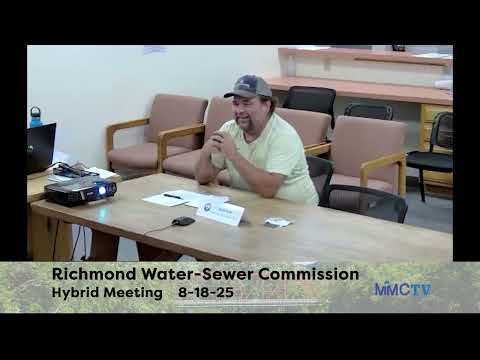
The Richmond Water and Sewer Commission on Aug. 18 said it has secured three signed easements needed to advance the Tilden Avenue, Bridal Street and Cochran Road waterline replacement project and discussed whether to install additional curb stops while crews are already excavating.
Chair (S1) opened the item by confirming the number of signed easements and asking staff who received hand-delivery lists to property owners. "I see that we have 2 signed easements regarding those today. Actually, there are 3," the Chair said, noting that most properties had received the paperwork and that three rental units would require mailing.
Why it matters: Commissioners and staff said acting now to install curb stops could reduce future expense and disruption for homeowners who later decide to connect service. Staff and commissioners also flagged the town’s allocation rules, explaining that properties that do not reserve water allocation now could face uncertainty if demand grows.
Staff member (S3) reviewed the allocation ordinance and explained its typical use for sewer reservations, noting that the water allocation practice follows similar procedures: "We need to know how much you're requesting, and the engineer signs off," S3 said, summarizing how allocations are documented by use type (e.g., bedrooms, restaurant, marine maintenance).
Public commenter/plant operator (S6) described the curb stop and how it is installed and maintained, noting town cost estimates: "The curb stops, I think, we're running right around $300. That's our cost," S6 said. He explained the curb stop is a buried shutoff valve with an access rod and protective cast-iron box and that the physical curb-stop installation will normally be paid for by the customer even though the town owns that infrastructure.
Commissioners pressed for clear documentation and locating measures so future crews will find curb stops if they are left in place for many years. "That's why we have the engineer doing that," S6 said, and staff described plans to record GPS coordinates and photograph each curb stop and include locations on blueprints.
Cost and permitting questions surfaced: commissioners asked whether a permit or zoning review is required when a homeowner later develops an accessory dwelling or expands use. Staff said the process for sewer and for water hookups may differ and that additional sewer work will still be required in many cases, so installing a curb stop now does not guarantee all future connections.
Next steps: Commissioners asked staff to provide an estimated homeowner cost range for a curb stop and to bring a curb-stop example for a show-and-tell at the Sept. 2 meeting. The Commission also agreed to mail easement packets to the three rental units that were not reached in person.
The Commission discussed broader supply and allocation issues tied to the project, including a future recommendation to track reserve capacity and allocation status at regular intervals to avoid reaching allocation limits.
The Commission did not take a separate formal vote on a curb-stop policy at the Aug. 18 meeting; commissioners directed staff to return with cost estimates and documentation steps and added a curb-stop demonstration to the Sept. 2 agenda.