Get Full Government Meeting Transcripts, Videos, & Alerts Forever!
Get email alerts on the Bess 339 Jerry Smith topic
No spam. Unsubscribe anytime.
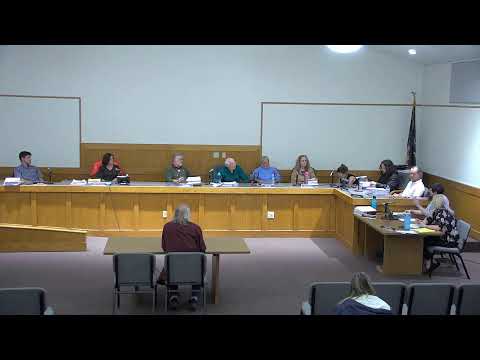
Planning board probes noise, safety and decommissioning for proposed battery storage project
Summary
At a lengthy review of a proposed large-scale battery energy storage system at 339 Jerry Smith Road, board members pressed applicants on noise modeling, nighttime charging schedules, visual screening, fire-access and turnaround dimensions, BMS/fire notification protocols, decommissioning plans and bonding; staff requested a long-form environmental assessment and consolidated consultant comments prior to the next hearing.
Applicant representatives presented engineering, acoustic and safety documents for a proposed large-scale battery energy storage system at 339 Jerry Smith Road and answered board questions about operations, siting and mitigation.
The applicant’s consultant explained that noise modeling used ambient measurements plus equipment profiles to forecast two standard output scenarios: a 40% operational profile (expected most of the time) and a 100% worst-case modeling output used to show an upper bound that the consultants said would not be expected in local climate conditions. The consultant said charging would occur primarily at night, within utility-mandated windows (stated as midnight–6 a.m.), and that most noise stems from cooling fans; the applicant added an acoustic fence and other mitigation measures to reduce sound by roughly six decibels.
Board members noted that the town does not currently have a noise ordinance and discussed whether the board could impose a condition limiting noise to “no more than 6 decibels over ambient,” which the applicant said it could accept and incorporate into conditions if requested.
Fire and emergency access was a central topic. Staff and board members raised the New York State fire code apparatus-access requirement (appendix D) that can require wider dead-end fire apparatus roads (26 feet for certain lengths). The applicant’s engineer said the site currently shows a 20-foot entrance and that if the road exceeded certain lengths it may trigger the 26-foot standard; staff said code enforcement would make final interpretations and recommended confirming turnaround dimensions so first responders can safely access the site. Board members pressed the applicants on first-responder access and on whether the site layout provided adequate vehicle turnaround in the event of a thermal-runaway or smoldering battery event; the applicant said cabinets are UL-rated and that a thermal event is expected to be smoldering rather than an outward flame, and that site space (often 25–30 feet) should provide response room.
The board also asked about emergency triggers: applicants said that each battery cabinet contains a battery management system (BMS) that automatically disconnects a failing unit and notifies the operator; for early operations the applicant confirmed errors would be communicated to the fire department. A board member flagged that the emergency response plan referenced the wrong local fire department name in one clause; the applicant agreed to correct site-specific certifications in the plan.
Decommissioning and lease terms drew extensive comment. The applicant said the systems are containerized and can be removed more straightforwardly than a solar array; they estimated a 20-year lease plus a 5-year extension (described as a 25-year operating period) and suggested decommissioning could be roughly half the time it took to build the facility. Board members requested a bond or decommissioning security and clarity on whether the town or landowner would be party to any decommissioning agreement; the applicant said standard practice is to ensure the town’s interests are secured and that the bond should cover town liabilities.
The applicant put a rough construction cost range on the facility around $10–12 million and said they plan to seek IDA incentives; they said community benefits (host payments) could be considered but are not mandated. The board asked about the visual impact and screening; the applicant said wetlands will be avoided, that limited tree clearing is proposed only for access, and that an acoustic fence and additional landscaping had been added since the board last saw the project.
Staff said they had received multiple consultant review letters and that the board should request the long-form environmental assessment form (EAF) because of species (northern long-eared bat) and wetland adjacency; several board members agreed the long form should be required and that consolidated review letters should be circulated before the next meeting. The board set a path to schedule a public hearing at the next meeting, contingent on consolidated review materials and a completed long-form EAF.
What happens next: applicants will provide consolidated consultant responses (stormwater, fire code, noise, ERP corrections), address the fire-access/dimensions and decommissioning/bonding questions and submit a long-form EAF for coordinated review prior to scheduling a full public hearing and potential action.