Get Full Government Meeting Transcripts, Videos, & Alerts Forever!
Get email alerts on the Zoning Rezoning topic
No spam. Unsubscribe anytime.
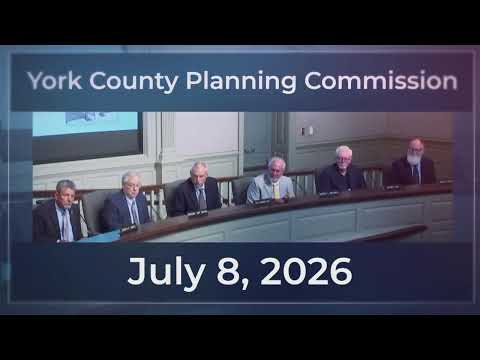
York County planning commission declines to recommend rezoning of Marquis Crossing after split vote
Summary
The commission voted 3–4 against recommending approval of PC26-17, a proposal to rezone 22 acres at 200 Water Country Parkway for up to 125 townhomes, a Sheetz convenience/gas site and commercial pads; staff had recommended denial citing incomplete mixed‑use commitments and plan guidance.
The York County Planning Commission on July 8 declined to recommend approval of PC26‑17, a rezoning request for a 22‑acre portion of 200 Water Country Parkway known as Marquis Crossing.
Staff presented PC26‑17 as a request to reclassify the parcel from Economic Opportunity (EO) to Planned Development‑Mixed Use (PDMU) for a development featuring up to 125 for‑sale townhomes, a Sheetz convenience/gas use on a 3.3‑acre pad, and two additional commercial outparcels. Staff told commissioners the proposal includes 2.7 acres of open space (exceeding the 2.2‑acre requirement for the 22‑acre site), traffic improvements recommended by VDOT, and a traffic impact analysis projecting about 8,510 daily trips. Staff estimated the project would generate roughly 47 new public‑school students and projected about $410,000 in annual real estate tax revenue, but recommended denial because the proposal does not fully meet the comprehensive plan’s mixed‑use guidance.
“The primary issue is whether the proposed land use is appropriate for this location,” staff said, noting that the comprehensive plan supports mixed‑use only when there is a genuine commitment to both residential and commercial components.
Representatives for the applicant, Roca Partners and Stanley Martin Homes, urged approval. Vernon Getty, representing the applicant, said the project had been revised after earlier review and that apartment uses were removed in favor of for‑sale townhomes. “We agree with almost all the staff report, frankly, except the ultimate conclusion,” Getty said, describing proffers intended to phase commercial pad development alongside the residential build‑out.
Applicant CEO Dan Hargett said the team has secured a long‑term lease with Sheetz and pointed to landscaping and site‑plan commitments to buffer residential areas from commercial uses. “We want to do whatever we can to make it as appealing as possible for the residential to coexist with the commercial,” Hargett said.
Commissioners pressed applicants and staff on several practical points: which internal streets would be public versus private; how setbacks and parking credits are measured; whether the traffic analysis accounted for interim occupancy thresholds (for example, what happens if 80 townhomes are occupied before full roadway improvements are completed); and whether the commercial‑floor‑area guidelines were applied to the commercial portion only or to the entire 22‑acre request. The applicant’s builder, Steve Miller of Stanley Martin, explained that the townhomes are primarily garage units and that parking credits for garages and driveways, plus roughly 60 dispersed community spaces, underlie the proposal’s parking totals.
The public hearing drew several residents who opposed and several who supported the proposal. Opponents cited traffic and safety on Water Country Parkway and Route 199, sight‑line and flooding problems at intersections, concerns about school capacity and long‑term capital costs, and the site’s archaeological and Civil‑War/Emanipation‑era history. Don Klein of Whitaker’s Mill told the commission he opposed the rezoning and urged further study of traffic and historic resources. “Water Country Parkway is at capacity,” Klein said. Other speakers, including several Whitaker’s Mill residents, supported the project for its potential to bring a gas/convenience use, additional customers to the Marquis shopping area, tax revenue and a developer‑funded plaque to highlight the site’s history.
After deliberation, the chair moved to adopt a recommendation of approval for PC26‑17. Roll call produced three votes in favor (Mister Smith, Mister Wathmore, Mister Titus) and four votes against (Mister Borrelli, Mister Chamberlain, Mister Butler, Mister Brooks). The motion failed, and the planning commission did not forward a recommendation of approval to the Board of Supervisors.
The commission also used the meeting to elect officers for fiscal year 2026–27 and to form a small bylaws subcommittee to review meeting times and other procedural issues. Staff closed with routine development updates.
What happens next: The planning commission’s failure to recommend approval does not itself rezone the property; the transcript records only the commission’s vote and the discussion. Any subsequent action — including whether the applicant revises the proposal or seeks action at the Board of Supervisors — was not stated in the recorded hearing.