Get Full Government Meeting Transcripts, Videos, & Alerts Forever!
Get email alerts on the Urine Diversion topic
No spam. Unsubscribe anytime.
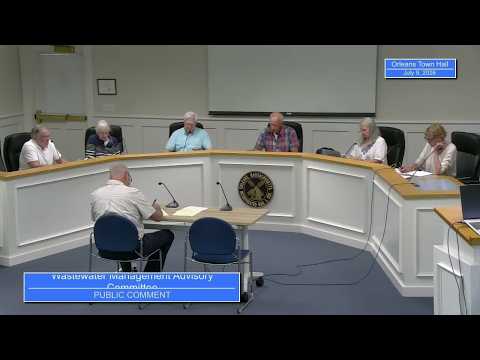
Test center briefs Orleans committee on urine‑diversion pilot and feasibility questions
Summary
Brian Horsley of the Barnstable County alternative septic test center told the committee about a Falmouth pilot to install 25 urine‑diverting or composting toilet systems, funded by town contributions and a DEP grant; members pressed on cost, homeowner behavior and whether MassDEP will grant TMDL credit.
Brian Horsley, a project assistant at the Massachusetts Alternative Septic System Test Center, briefed the Orleans wastewater committee on a regional pilot that is testing urine‑diverting and composting toilets as tools to reduce nitrogen loading to coastal waters. He said the test center, a division of the Barnstable County Department of Health and Environment, has helped design a Falmouth project that aims to install about 25 systems drawn from roughly 170 households that expressed interest.
Horsley described the technical rationale: “the conventional water‑flush toilet is where about 90% of the nutrient pollution enters our on‑site septic system,” and urine accounts for roughly 80% of the nitrogen load, so source separation could sharply cut household nitrogen to groundwater. He said the test center has support from multiple funding sources: an intermunicipal contribution of about $230,000 from the town to the test center and a Department of Environmental Protection grant of about $417,000 (DEP 319 program) to move the project into field testing and permitting.
Why it matters: the center will monitor installed systems to produce real‑world data the DEP can use to decide whether these technologies should count toward nitrogen load reductions under TMDL planning. Horsley said the project will sample septic effluent and measure captured urine volumes so the team can quantify kilograms of nitrogen removed and account for any ammonia off‑gassing from storage.
Cost and uptake remain open questions. Horsley gave current installer estimates of $7,000–$15,000 per home for urine‑diverting systems (depending on bathroom counts and tank location) and said composting systems may run roughly $10,000–$20,000. “Those are estimates that our plumber gave us,” Horsley said; the pilot is intended to refine actual installation and maintenance costs. The grant includes reimbursement up to $8,250 per participating household, and Horsley said the team will screen interested homes to try to assemble a mix of new‑build and retrofit cases.
Committee members pressed on practical constraints. Judith Bruce cautioned that many local homes have multiple, non‑aligned bathrooms and finished basements that make retrofits complex and costly, and she noted homeowners lose storage or living space for tanks. “When you speak to a cost of 7 to 15,000, I look at my own house — three bathrooms on three floors — and that’s major reconstruction,” Bruce said.
Board of Health designee John Smith raised behavioral concerns: how reliably will residents use these systems, how often will tanks require pumping, and how will gray water sources (dishwashers, laundry) still feed nutrients to conventional treatment? Horsley acknowledged behavior matters and suggested municipal and public facilities (urinals, pre‑plumbed public buildings) as early, low‑behavior options.
Water‑quality and safety questions were also raised. Committee member Bob Mullen asked about PFAS in urine and whether treated urine would be safe for land application; Horsley said Rich Earth Institute and Brightwater Tools have analyzed processed urine and found mostly non‑detect levels for regulated PFAS compounds but recommended continued monitoring and cautious use on food crops.
Accounting for regulatory credit is a central uncertainty. Mike Giggy of Wright‑Pierce reviewed local analysis and cautioned that existing regulatory accounting (Mass Estuary Project/M.E.P.) and real‑world capture rates can substantially reduce the number of kilograms credited per household. Giggy said that under current MEP accounting, creditable removal per household could be only a few kilograms per year if capture and behavioral factors are accounted for.
Next steps: Horsley said the test center will proceed with site selection, field installations and QA‑approved monitoring designed for DEP review; he agreed to share his slide deck with the committee for posting on the town website. The committee plans to follow the pilot’s data as it considers whether to support broader use of these systems or to recommend pre‑plumbing public projects as lower‑risk initial steps.
The committee will revisit the pilot as part of its upcoming agenda and as Falmouth’s monitoring produces results that could support DEP consideration of nitrogen credits.