Get Full Government Meeting Transcripts, Videos, & Alerts Forever!
Get email alerts on the Urban Woodlands Ordinance topic
No spam. Unsubscribe anytime.
Springfield committee restarts debate on proposed urban woodlands ordinance
Summary
The Springfield City Sustainability and Environment Subcommittee reopened discussion of a draft urban woodlands ordinance that would curb large-scale clear-cutting, create a review commission and require mitigation payments; members asked for clearer DBH and parcel-size definitions and scheduled a follow-up in three weeks.
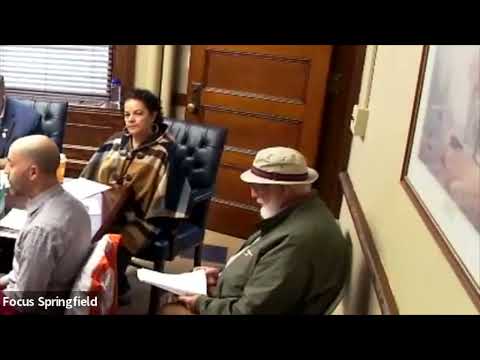
Councilor Victor Dowdle, chair of the Springfield City Sustainability and Environment Subcommittee, called a meeting Monday to restart work on a proposed urban woodlands ordinance intended to limit large-scale tree clearing on privately owned parcels and to create an Urban Woodlands Review Commission.
Presenter Jay Natoli told the subcommittee the draft would "prohibit a wide-scale unadulterated clear cutting," require applicants to petition the city for significant removals, create a review commission with authority to judge appropriateness, and require mitigation payments and tree replacement if clearing were approved. "The goal here really is to just restart the conversation, take a pulse check from the council," Natoli said.
Why it matters: Forester Alex briefed the group on measurement and canopy impacts, saying "So citywide, we're at about 36%." He added the Forest Service target is roughly 40 percent canopy and that coverage is uneven across neighborhoods — a disparity the ordinance aims to address by preserving mature tree canopy in vulnerable areas.
Councilors and panelists focused much of the discussion on technical definitions that determine the ordinance's scope. Members flagged apparent inconsistencies in the draft between a 4-inch and a 6-inch diameter-at-breast-height (DBH) threshold, and questioned the parcel-size trigger, which the draft currently sets at 5,000 square feet with a 10-tree minimum to qualify as a woodland. The forester explained DBH is typically measured at 4.5 feet above grade and that a 4-inch DBH tree could be about 20 to 25 years old depending on growing conditions.
Presenters stressed that the measure was not intended to burden ordinary homeowner activity. Under the current draft, owner-occupants removing fewer than five trees would not be subject to the ordinance; removals of five to nine trees could qualify for a residential exemption processed by the Urban Woodlands Commission, while larger removals would trigger the full review.
The meeting also addressed enforcement and funding. Natoli said the draft contemplates financial penalties for violations and that the intent is to deposit any lawful fees into a tree-replacement or mitigation fund. Alex and the solicitor clarified that the city already has a tree replacement fund that receives fees when developers remove public shade trees under an approved process, and that existing illegal-cutting fines referenced in Chapter 87 are directed to the general fund rather than the replacement fund.
The city solicitor and a representative of a citizen action group urged caution about scope and enforceability, warning that a broadly written ordinance that applied to nearly every private lot would be legally and administratively difficult to enforce. The solicitor emphasized the need to define how a review commission would operate, who appoints its members and the practical staffing required for enforcement.
Councilors proposed several next steps: clarify the DBH and woodland definitions in plain language, consider splitting the work into separate ordinances (one for large swaths and another for small-lot residential issues), assess whether the conservation commission could take on review duties, and circulate revised maps showing affected parcels. The subcommittee agreed to reconvene in three weeks to review revised language and materials.
Vern McCarver, a resident who identified himself during the meeting, said he was encouraged by the tone of the discussion: "I am just very pleased with the tenor of this meeting," he said.
The subcommittee did not vote on the ordinance. Councilor Dowdle adjourned the meeting and said staff would circulate a revised draft and maps ahead of the next session.