Get Full Government Meeting Transcripts, Videos, & Alerts Forever!
Get email alerts on the Bridges topic
No spam. Unsubscribe anytime.
Northfield engineers outline multi-bridge rehab plan for Cox Brook Road, estimate $4.5M–$5.9M and 2031 construction
Summary
Vermont Agency of Transportation and Hoyle Tanner presented scoping for three deteriorating covered bridges on Cox Brook/Dock River, including repair options, traffic-control scenarios that change the town's share (5% vs. 2.5%), and a proposed vehicle-height detection system priced at about $125,000.
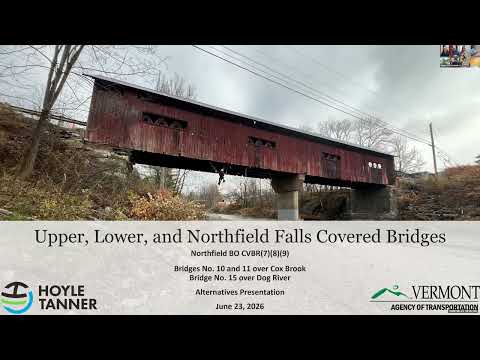
Hoyle Tanner engineers and VTrans staff told the Northfield Select Board on Tuesday that three covered bridges on Cox Brook and the Dock River require substantial rehabilitation and presented a set of repair options, cost estimates and a multiyear schedule.
The scoping team said the work would address structural deterioration, extend the bridges' service life and improve safety for pedestrians and vehicular traffic. "The purpose of the project is to provide a safe crossing over Cocksbrook and Docker River for the traveling public," the lead presenter said during the meeting, summarizing the project's aim and the need for rehabilitation.
Why it matters: All three historic bridges — the Upper, Lower and Falls bridges — carry local traffic but have components rated in the poor-to-fair range on a 1–9 condition scale that the presenters used. The board heard that choices about traffic control during work (building temporary bridges or closing and detouring traffic) materially affect both construction logistics and the town's out-of-pocket cost.
Condition, options and costs: The Upper bridge was described as having a 4/9 overall condition rating with high moisture readings in timber members and extensive corrosion in steel elements. Presenters showed alternatives ranging from replacing steel stringers to installing shallower, precast concrete deck beams inside the covered superstructure. They said concrete deck beams can gain about 1 foot of freeboard in a 50-year flood scenario and create a smoother underside that traps less debris than some steel options.
Cost estimates presented to the board put component alternatives for single-bridge work in the low millions: one temporary-bridge construction scenario was shown at roughly $2.1M'$2.4M (with a 5% town share of just over $100,000 for that option). The combined estimate for the three-bridge program was given as about $4.5M'$5.9M; presenters noted those figures are 2026-dollar engineering estimates and urged boards to expect escalation over time.
Funding share rules and trade-offs: VTrans staff explained a state rule (Act 153, 2012) that reduces a municipality's share for a rehabilitation project to 5% and further reduces it to 2.5% if the town elects an off-site detour rather than building temporary bridges during construction. VTrans staff noted the example numbers: choosing the detour approach could reduce a town share from roughly $135,000'$147,000 (5%) to about 2.5% ($75,000'$77,000) depending on the chosen alternative.
Traffic control and community impacts: Presenters recommended measures to protect portals, roofing and truss members and to reduce impacts on pedestrians, including a one- to two-foot timber curb and narrowing the traffic lane through the covered bridges to encourage vehicles to stay centered. Residents raised concerns about winter plowing, driveway access during construction and whether a narrow curb would hamper pedestrians in snowy conditions; engineers said contractors would be required to maintain property access and that some short-term coordination would be unavoidable.
Vehicle-detection system: To reduce over-height strikes, the team described a laser-based vehicle-detection and warning system that would flash lights (and optionally capture images) if an approaching vehicle exceeds a configured height. The presenters said a three-bridge system setup was quoted at about $125,000, with ongoing maintenance and monitoring costs likely borne by the town; federal cost participation (FHWA) was described as possible but not confirmed.
Schedule and next steps: The scoping report will be finalized and submitted to VTrans; presenters anticipated the design phase beginning in 2029, with advertisement and contractor bids to follow and construction currently targeted for 2031. Presenters emphasized that contractor capacity and construction inflation are material risks and that the town should expect cost escalation between the 2026 estimate and the start of construction.
The board did not take a final vote on a preferred alternative; the scoping report will move to VTrans, and staff said the next steps include final design, further property-rights work for temporary easements if needed, and public outreach to affected property owners.