Get Full Government Meeting Transcripts, Videos, & Alerts Forever!
Get email alerts on the Invasive Plant Program topic
No spam. Unsubscribe anytime.
Maine Forest Service outlines grants, deadlines for invasive-plant control plans
Summary
Maine Forest Service staff told Invasive Plant Academy participants that application and treatment funding tied to a USDA Landscape Scale Restoration grant is open through the end of August; plans must be submitted to the agency by Dec. 31 and payment documentation by April 30, 2025.
Jan Santerre, urban and community forestry program coordinator at the Maine Forest Service, told participants in the Invasive Plant Academy that funds from a USDA Forest Service Landscape Scale Restoration grant are available to support development of invasive plant control practice plans and treatments.
"Graduates of the invasive plant academy at any point during this grant will be grandfathered into any future funding that we receive for continuing this work," Santerre said, explaining that trained preparers will be listed on the program website and can assist landowners with plan development and applications.
Why it matters: The current Landscape Scale Restoration grant is in its final year, Santerre said, and the Maine Forest Service is applying for additional funds. Participants and landowners who want reimbursement must meet application and documentation deadlines tied to the grant timeline.
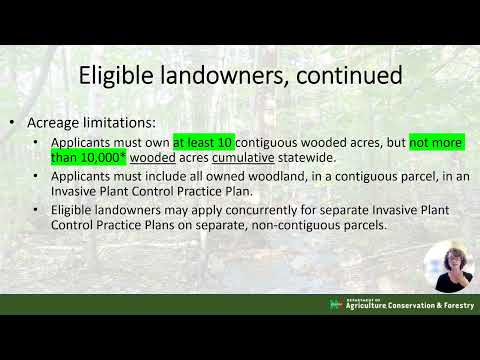
Who can apply and scope: Santerre said eligible applicants include private family woodland owners, municipalities, water and utility districts, soil and water conservation districts, schools and other educational institutions, land-owning institutions, land trusts, and nonprofit entities. Applicants must own at least 10 contiguous wooded acres and not more than 10,000 wooded acres cumulatively statewide; separate noncontiguous parcels may be the subject of separate applications.
Process and timing: The agency has moved from paper forms to an online submission process that requires client and vendor information at the time of application. Santerre said plan applications and a separate treatment application ranking period are open through the end of August, with approval letters anticipated by the second week of September. Field work should be completed after approval and by the end of October, and completed plans must be submitted to the Maine Forest Service by Dec. 31. For payment, Santerre said all documentation related to approved applications must be submitted to the Maine Forest Service by April 30, 2025, in order to receive payment; reimbursements are processed on a rolling basis and typically issued about six weeks after submission to the state treasurer's office.
Treatment funding and conditions: Santerre emphasized that treatment funds are only available to landowners who have an approved invasive plant control practice plan. She said treatment awards would be contingent on completion of the approved plan. If current funds are not fully allocated, the agency may open an additional brief application round to use remaining funds.
Field survey guidance: Nicole Rogers, landowner outreach forester at the Maine Forest Service, discussed minimum survey requirements and time estimates for conducting property inventories. "So it could be between a 100 to 250 acres per day," Rogers said, adding that the acreage a practitioner can cover depends on infestation intensity and their familiarity with invasive plant identification. Rogers gave examples: a lightly infested 50-acre property might take two to four hours to survey; about 100 eligible acres could take a full day; surveying 250 acres should budget roughly 10 hours; and high-infestation 500-acre sites may require 32 or more hours.
Program materials and support: Santerre said the program website and upcoming manual include application forms, landowner instructions, claim-for-payment and affidavit forms, example practice plans, checklists used by district foresters, and flow diagrams describing the application and reimbursement process. She encouraged participants to reach out to program staff with questions and to encourage landowners to apply.
Next steps: The Maine Forest Service is applying for additional Landscape Scale Restoration funding. Participants were urged to submit complete applications during the current open period through the end of August and to ensure all payment documentation is filed by April 30, 2025, to be eligible for reimbursement.