Get Full Government Meeting Transcripts, Videos, & Alerts Forever!
Get email alerts on the Bangor Eab Response Plan topic
No spam. Unsubscribe anytime.
Bangor presents EAB response plan after 2024 inventory finds 1,854 public ash trees
Summary
City of Bangor forestry staff and a University of Maine intern presented a 2024 urban tree inventory (8,574 trees), identified 1,854 ash in the public canopy (≈20%), and outlined removal, treatment (emamectin benzoate injections), replacement and outreach strategies, with preliminary 10‑year cost estimates.
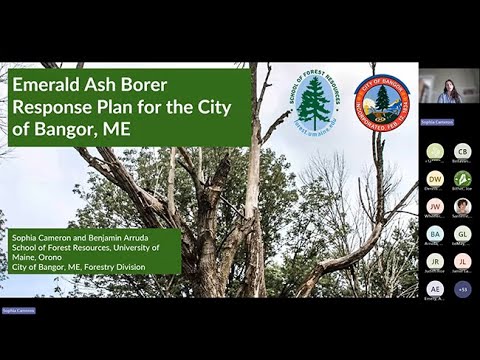
Sophie Cameron, a master’s of forestry student at the University of Maine and author of the City of Bangor EAB response plan, and Ben Bridal, Bangor’s city forest manager, presented the city’s inventory‑driven approach to EAB management.
"There were 8,574 trees inspected in 2024. 1,854 of those were an ash species," Cameron said, reporting that ash accounts for roughly 20% of Bangor’s mapped urban canopy. She told listeners the city used ArcGIS field maps and i‑Tree Eco to create a per‑tree inventory that supports targeted treatment and removal decisions.
Bangor’s strategy, Cameron said, divides trees into prioritized bins: immediate removals for hazardous trees, treatment for high‑value healthy trees, and staged removals for lower‑risk trees. The city plans initial injections of emamectin benzoate on a three‑year cycle (applied at a slightly higher rate of 3 ml/inch DBH in this plan) over a nine‑year treatment window to protect selected trees. Cameron said 250 trees were selected for initial treatment, 436 were flagged as required removals, leaving roughly 1,168 ash trees under consideration for treatment, removal or replacement.
Cost estimates presented to the webinar audience included roughly $36,000 to treat more trees (discounted over a 10‑year projection) and about $582,000 to remove additional trees over the same period, not including replacement planting costs. Cameron also estimated the ecosystem services value of the 1,168 remaining ash at more than $7,000,000 across the 10‑year horizon.
Ben Bridal outlined municipal property management and forest parcels that factor into priorities: Bangor manages approximately 361 properties (from small parks and cemeteries to the airport complex), and the city plans fixed‑interval inventory plots in wooded parks and permanent tagging on high‑use trails to identify ash hotspots and hazard trees. Bridal said municipal woody biomass handling (about 5,000 tons in 2024) currently goes to a contractor for grinding/biomass use and that large‑scale revenue from disposal is unlikely at current market rates.
The city emphasized outreach and tools to involve residents: SeeClickFix features were added so citizens can report private ash trees and potential EAB sightings that forestry staff will verify, and engagement with schools, the local media, Wabanaki partners and basket‑makers was described as part of wood‑utilization and public education planning.
Bangor staff said they are leaning toward treating additional trees in the near term while continuing to refine removal and replacement sequencing; they asked for stakeholder input on trade‑offs and on whether to expand in‑house capacity or hire contractors for large volumes of removals.