Get Full Government Meeting Transcripts, Videos, & Alerts Forever!
Get email alerts on the Tree Growth topic
No spam. Unsubscribe anytime.
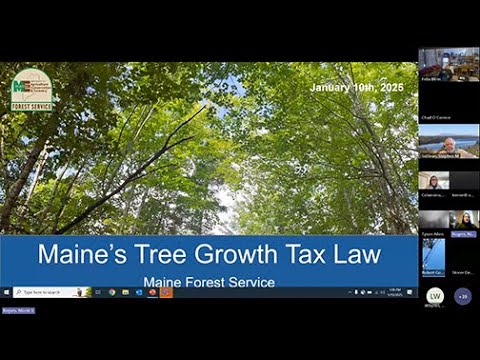
Maine Forest Service webinar explains tree growth tax law, eligibility and withdrawal penalties
Summary
Maine Forest Service presenters outlined who qualifies for the state's Tree Growth current-use property tax program, application and recertification steps, and types of withdrawal and penalties; presenters urged landowners to consult licensed foresters and Maine Revenue Services for county rates and calculations.
Nicole, a presenter with the Maine Forest Service, summarized how the state's Tree Growth current-use property tax program works and what landowners must do to enroll and remain eligible. The online session focused on eligibility (minimum acreage and primary objectives), application mechanics, recertification and the financial consequences of withdrawing from the program.
Why it matters: Tree Growth changes the assessed value of forest land to reflect its current use, not its highest-and-best market use, which can reduce property taxes for owners committed to long-term forest management but also creates potential withdrawal penalties that can be substantial.
The program basics and eligibility
Nicole said a property must include at least 10 contiguous acres of productive forest and that the owner's primary objective for that land must be growing and harvesting commercial forest products. A forest management plan written by a licensed forester is required and must be recertified every 10 years. "Enrollment of a property stays with the property, not the owner," Nicole said, noting that a new owner has one year after transfer to file an application to remain in the program or to adopt or prepare a new plan.
What counts as a commercial product and what does not
Presenters listed typical commercial forest products (saw logs, pulpwood and commercially sold firewood) and said some products often discussed by landowners''such as berries, nuts and mushrooms''generally do not qualify as commercial forest products under the Tree Growth rules unless produced at a commercial scale.
Application and valuation
Morton (Maine Forest Service presenter) explained that Maine Revenue Services sets the per-acre rates by county and forest type (softwood, hardwood, mixed) and that the assessed value for enrolled forestland is calculated by multiplying acres by the published per-acre rate. Morton directed landowners to the Maine Revenue Services website for the official published rates and said the Maine Forest Service typically reposts those numbers after release.
Management plans, confidentiality and harvesting
Plans must be prepared by a licensed forester and are treated as private documents, Nicole said; assessors may request to inspect a plan but must return it. There is no statutory requirement to harvest within the first year or within any particular first decade, she said, but the plan should document a schedule of activities and any deviations should be recorded.
Withdrawal, penalties and assessor notices
Nicole outlined two broad withdrawal paths: voluntary withdrawal (a one-time penalty) and forced withdrawal (assessor-initiated if program requirements are not met). Automatic withdrawal can occur if enrolled acreage is subdivided so that less than 10 contiguous acres remain. She advised consulting Tax Bulletin 19 for penalty-calculation details. Lisa, who identified herself during the Q&A, added that assessors must notify landowners before withdrawal: "you're gonna get a notice by certified mail 120 to 180 days ahead" and noted statute allows an assessor to add an additional 25% penalty for failure to notify in some circumstances.
Resources, costs and next steps
Presenters said licensed foresters commonly charge for initial plan preparation and for recertification updates, though recertification is often less costly than writing the first plan. Cost-share programs such as the Maine Forest Service's Woods Wise assistance and NRCS programs can help defray plan-writing costs. Morton noted the Maine Revenue Services website contains the official per-acre rates, and that staff posted a link in the chat during the webinar.
Questions and follow-up
Presenters answered participant questions about agroforestry, harvesting arrangements, whether buyers can adopt sellers' plans (possible but often clearer to draft a new plan for the specific parcel), moving enrolled land to other current-use categories and whether forested wetlands count toward acreage (they count only if they are productive for commercial forest products). The presenters also promoted upcoming outreach (the Agricultural Show in Augusta and Maine Woodland Owners programs) and said the webinar recording and materials will be posted on the Maine Forest Service website.
The session closed with presenters offering contact information for follow-up: Maine Forest Service district foresters and Maine Revenue Services for valuation questions.