Get Full Government Meeting Transcripts, Videos, & Alerts Forever!
Get email alerts on the Browntail Moth topic
No spam. Unsubscribe anytime.
Maine Forest Service: Browntail moth defoliation fell sharply in 2024; $150,000 mitigation fund supported local removal and outreach
Summary
Maine Forest Service entomologists reported a statewide drop in browntail moth defoliation from roughly 46,000 acres (2023 aerial survey) to about 2,000 acres in 2024, credited in part to natural pathogens and targeted local actions funded by a one-time $150,000 mitigation grant program.
Brittney Schapack, forest entomologist with the Maine Forest Service, told municipal tree managers that browntail moth remains a concern for public health and tree health but that 2024 showed a substantial decline in observed defoliation.
The decline was evident in aerial and ground surveys: "In 2023 we charted just about 46,000 acres" of defoliation in coastal Maine, Schapack said, while in 2024 survey mapping covered a little over 2,000 acres. Schapack and staff point to a mix of factors, including natural pathogens and weather patterns that favored fungal and viral agents, as contributors to the drop.
"There was a Goldilocks effect" in 2024, Schapack said, describing how rainfall patterns this year were favorable to pathogen spread (not so wet that spores could not disperse, not so dry that fungi failed to establish). She highlighted two naturally occurring controls — a native fungus and nuclear polyhedrosis virus — that can cause localized mortality in brown tail caterpillar groups when conditions allow.
State staff also described how a one-time mitigation fund of $150,000 was distributed to towns and organizations for projects that focused on mechanical removal, targeted pesticide application, and community education. Examples Schapack cited included signage and outreach materials at Coastal Maine Botanical Gardens, school-based clipping parties in Pownal that engaged fifth graders, and library-based rental programs for extendable pole pruners to support community clipping events.
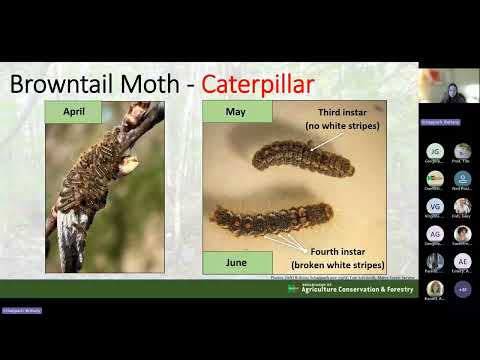
Schapack emphasized timed, targeted work over broad treatments. She said the most effective interventions are done when caterpillars are very small: "If the timing of these pesticides are wrong, they're too late... you want to kill them when they're still really small." She contrasted tree injection (drilling into trunks to deliver systemic pesticide) with foliar sprays, noting injection is suitable near water and tends to reduce off-target drift, while foliar sprays carry more drift risk and have strict buffers near water.
On safe removal, Schapack advised clipping winter webs before spring emergence and destroying them in soapy water or by burning (with permits when required). She described the "4 Rs" of community response: recognition, removal, recruitment of help (licensed arborists, FAA-certified drone operators, licensed applicators), and reaching out to neighbors to coordinate mitigation.
Local efforts funded by the mitigation program varied: some towns reimbursed homeowners for treatment of heavily infested trees; Pine Island Camp piloted drone clipping for tall trees; and the town of Plymouth directed funds to University of Maine research led by Angela Mech. Schapack noted that about half of surveyed development sites showed pathogens in 2024, especially in southern survey locations, and that public photo reports helped confirm at least nine additional towns with pathogen presence.
Schapack closed by urging municipal staff and residents to scout winter webs through March, consider February Browntail Moth Awareness Month events, and follow label directions or hire licensed applicators when pesticide treatment is selected. She left contact information for follow-up questions and resources (ma ine.gov/dacf/knockoutroundtailmoth) and noted that the mitigation funding for 2024 was a one-time allocation.
The webinar hosts invited follow-up questions via chat and email and said the Maine Forest Service will continue outreach and provide seasonal updates to subscribers.