Get Full Government Meeting Transcripts, Videos, & Alerts Forever!
Get email alerts on the Utility Adjustment topic
No spam. Unsubscribe anytime.
Mountain View staff outlines one‑time utility adjustment process to fold utilities into rent under CSFRA
Summary
City staff explained the one‑time utility adjustment petition process under the Community Stabilization and Fair Rent Act: how utilities will be converted into a fixed rent amount for covered units, what utilities are included, tenant response rights, and implementation timing.
Amanda, a city staff member with the rental housing office, onlined a tenant workshop explaining Mountain View’s one‑time utility adjustment petition process under the Community Stabilization and Fair Rent Act (CSFRA).
The city launched the process to convert non‑submetered utility charges landlords have been collecting — commonly billed through ratio utility billing systems (RUBS) or third‑party billing — into a fixed utility adjustment included in tenants’ total rent, Amanda said. "The outcome of the one‑time utility adjustment petition process would be that your current rent plus the separate utility adjustment would be added, and that would be your total rent amount," she said.
The nut‑graf: the change aims to prevent monthly utility‑billing swings that occur when tenants pay landlords or third‑party billing services for utilities. Amanda said the rental housing committee approved the calculation method staff are using to determine a per‑unit adjustment and that the regulation banning RUBS took effect March 1, 2024. Tenancies that began on or after that date must already include utilities in rent; tenancies that began before that date may be eligible for this one‑time petition process.
What utilities are covered and what is not
City staff told tenants the adjustment generally covers water, sewer, trash, gas and electricity when those charges are paid to a landlord or third‑party billing service. Amanda said utilities billed directly to a tenant by a utility company — for example, PG&E charges paid directly by the tenant — are exempt from the petition. She said cable and Wi‑Fi are outside the regulation and "may be property‑by‑property" in how they are managed.
How the petition works
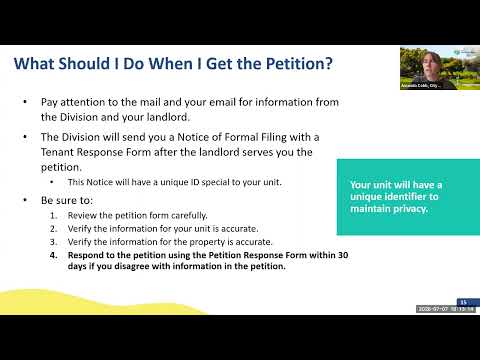
Landlords file a property‑wide petition with the city and supply workbooks of utility bills, common‑area facility data and unit details such as room counts. Staff review petitions in order received, checking completeness and accuracy; larger properties are prioritized in the current review queue. After staff accepts a complete petition, landlords serve tenants and the city sends tenants a notice of filing plus a tenant response form that begins a 30‑day response period for tenants to flag errors or provide supporting documents.
Amanda said staff will re‑review petitions after the tenant response period, may request additional documentation (for example, a lease), and then compute a final adjustment by averaging utility charges for the same billing period. Because these systems are not metered at the unit level, staff compare the newly assigned adjustment to what tenants had been paying under RUBS and expect some differences in individual unit assignments.
Timing and implementation
Staff will send a notice of final determination to landlords and tenants stating the assigned adjustment and whether it is upward or downward. Amanda said downward adjustments (where the assigned amount is lower than tenants’ prior RUBS charges) must be implemented as soon as administratively feasible; she estimated the landlord has about 60 days (30 days to send a rent decrease notice followed by 30 days for the change to take effect). "So once the one‑time utility adjustment is added to the tenant’s rent, they are no longer responsible for paying RUBS charges," she said, while noting there may be overlap for bills posted in arrears.
If the final adjustment is higher than what tenants previously paid, landlords may not add the increase to rent until the tenant’s next allowable rent increase — typically one year after the prior rent increase — per CSFRA restrictions.
Limits and tenant options
Amanda said the city cannot impose blanket rent decreases; decreases require a formal petition showing a reduction in housing services (for example, loss of a pool or a parking space) and would be decided through a hearing officer process. She urged tenants to review the tenant response packet carefully because details such as room count can change a unit’s assigned amount.
Resources
City staff pointed tenants to the housing help center, partner legal aid organizations, the community services agency and occasional participation by affordable housing providers and HouseKeys for help with the review and appeals process. Amanda provided contact information for follow‑up questions and assistance.
Questions raised by participants
Resident Alexander, who participated in the workshop, praised the change and asked whether garbage and Wi‑Fi would be included; Amanda confirmed garbage (trash) is included with the other core utilities but that Wi‑Fi and cable are outside the current regulation. Alexander also asked whether new construction is covered; Amanda said CSFRA does not apply to new buildings, so those tenants would not be covered by this local law.
What happens next
Staff are continuing the administrative reviews of landlord petitions and will notify tenants and landlords of final determinations after the tenant response period and any required follow‑up. For tenants unsure whether their unit is covered, Amanda said the office website includes a map where an address can be entered to check CSFRA coverage.
The workshop concluded with staff offering further help through the housing help center and partner organizations.