Get Full Government Meeting Transcripts, Videos, & Alerts Forever!
Get email alerts on the Imap Invasives topic
No spam. Unsubscribe anytime.
Maine biologist demonstrates IMAP Invasives app, stresses offline data collection and photo quality
Summary
Chad Hammer of the Maine Department of Agriculture, Conservation and Forestry walked attendees through IMAP Invasives — showing how to set up an account, record invasive-species observations offline with a mobile app, and submit records for confirmation by jurisdictional admins.
Chad Hammer, an invasive-plant biologist with the Maine Department of Agriculture, Conservation and Forestry’s Natural Areas Program, demonstrated the IMAP Invasives mapping platform and mobile apps and urged users to create clear photos and register their accounts so Maine’s statewide data are complete.
Hammer said IMAP Invasives is “a central repository for invasive species data,” used to collect and aggregate presence, treatment and not-detected records for plants and other organisms. He noted the platform is owned and developed by NatureServe and that Maine maintains a statewide jurisdiction on the service.
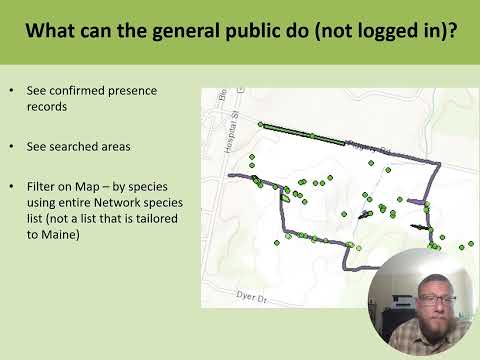
Why it matters: statewide participation helps managers spot new incursions and track treatment effectiveness. Hammer said residents, citizen scientists, foresters, land managers and researchers can all contribute observations; Maine pays for statewide access so registered users in the state can enter and view richer data.
How to start: Hammer walked through sign-up steps at imapinvasives.org — click “login,” fill out the sign-up form, choose the jurisdiction “Maine,” and confirm the account by email. He recommended signing into the mobile app before going into the field.
Using the mobile app: Hammer emphasized a key advantage of IMAP’s mobile app: “you do not need connectivity to collect data” in the field; the device records coordinates via its satellite receiver and stores observations locally until the user reconnects. He demonstrated adding an observation (take a close, in-focus photo, select the species or “not detected,” and let GPS pin the location or place a pin manually). He advised users to include scale in photos (a hand or pen) to aid confirmation.
Data types and confirmation: IMAP records begin as unconfirmed and jurisdictional admins review photos and metadata to change status to confirmed. Hammer said clear, close-up photographs greatly increase the chance a record will be confirmed; poor-quality images can prevent verification (he used hemlock woolly adelgid and honeysuckle examples).
Mobile vs. desktop: the IMAP Invasives mobile app is optimized for creating point observations; users who need to create lines, polygons or detailed treatment records should use IMAP online on a browser or the Survey 1-2-3 app. Hammer recommended filtering to the Maine jurisdiction on the desktop when running national-level queries to improve performance.
Project and organization features: users may optionally join or create organizations and projects to group records, track treatments, and share data with collaborators. Hammer said jurisdictional admins can bulk-upload data and that he can assist with creating organizations for plant-focused projects.
Uploading and verification: when back in range, users upload stored (yellow) records via the app’s menu (select individually or “select all”), confirm the upload, and the records disappear from the phone once synced. Hammer suggested verifying and editing test records via the desktop site and removing any fake test entries once finished.
Help and follow-up: Hammer directed attendees to IMAP network health resources and user manuals and to instructional videos (including New York’s IMAP Invasives YouTube channel). He offered his contact for follow-up: chan.hammer@maine.gov and said a later desktop demonstration video will cover advanced mapping features.
The demonstration lasted through a mobile-app walkthrough and closed with resources and an offer of assistance for setting up projects and accounts.