Get Full Government Meeting Transcripts, Videos, & Alerts Forever!
Get email alerts on the Municipal Budget topic
No spam. Unsubscribe anytime.
Temple Terrace previews FY27 budget with no millage increase; public-safety costs and a possible state homestead change loom
Summary
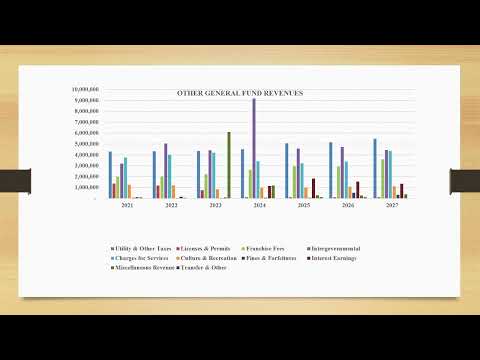
City staff presented a $41.38 million preliminary FY27 general fund with no proposed millage increase — the 10th straight year — while flagging rising pension and union costs for police and fire and a potential $2.6M–$4.0M ad valorem shortfall if a November constitutional amendment passes.
City of Temple Terrace staff on Tuesday presented a preliminary FY27 general fund budget of $41,377,705 and said they are not proposing a property tax rate increase, which would mark the 10th consecutive year without a millage change if the council adopts the plan.
The presentation, delivered by Mister Baillier, laid out key assumptions and constraints for the coming fiscal year, including a modest 1.71% projected growth in the property tax base — the lowest growth rate in a decade — which is expected to produce roughly $337,762 in new ad valorem revenue compared with an $825,338 gain projected the prior year. “This will be the 10th straight year with no increase in millage,” Baillier told the council.
The budget continues the city’s recent practice of modest employee pay adjustments; the FY26 year included a 4% cost-of-living adjustment and a 2% merit increase for general employees, and the FY27 proposal maintains funding for competitive pay and benefits while fully funding existing general-fund positions. But staff warned that personnel are essentially fixed costs: they estimate 79% of general fund spending is personnel related.
Council members pressed staff on several pressure points. Schisler asked whether FEMA reimbursements had already been recognized; staff said the city has not yet booked the majority of those receipts and expects to recognize some FEMA revenue in FY27. Kravitz and other members raised concerns about recurring operating expenses being shifted into funds traditionally used for capital or improvements and urged transparent naming and consistent reporting.
Public safety pension and contract costs are a major driver of the increase in personnel spending. Baillier reviewed actuarial-driven higher pension contributions and placeholder contract adjustments: a $328,719 increase for the police pension, a $337,911 increase for the fire pension, a programmed $426,907 placeholder for a pending police union contract negotiation, and a $355,730 increase for the fire union third year — contributing to roughly a $1.6 million net increase for the two departments combined.
To balance the budget, staff proposed a mix of strategies including carrying forward unspent FY26 appropriations as FY27 carryover, modest reallocation of administrative overhead charges to the Community Redevelopment Agency (CRA) (about $484,528), recognizing an estimated $170,429 in FEMA revenue in FY27, reallocating interest earnings ($~165,000) into general fund revenue, and a conservative $150,000 assumed reduction in building-fund subsidy pending fee study results.
The administration highlighted a strong unassigned fund balance (projected around 34.04%), above previously adopted 20%–25% targets — a level the city said supports liquidity for operations and strengthens debt-market positioning. Baillier cautioned, however, that a state constitutional amendment on the November ballot that would expand homestead exemptions could materially reduce ad valorem revenue: staff estimated a $2.6 million loss in FY28 under the first-step scenario and up to $4.0 million in FY29 if a larger exemption takes effect. “Those are very, very significant numbers,” Baillier said, urging council and the public to consider mitigation options, including fee changes and assessments, should voters approve the amendment.
Council members said they want further data and directed staff to return with detailed answers at scheduled follow-ups in late July and an August water/sewer workshop. The council did not vote on the budget at the workshop; staff cited the schedule for formal public hearings and a separate millage-setting meeting anticipated in early August.