Get Full Government Meeting Transcripts, Videos, & Alerts Forever!
Get email alerts on the Budget topic
No spam. Unsubscribe anytime.
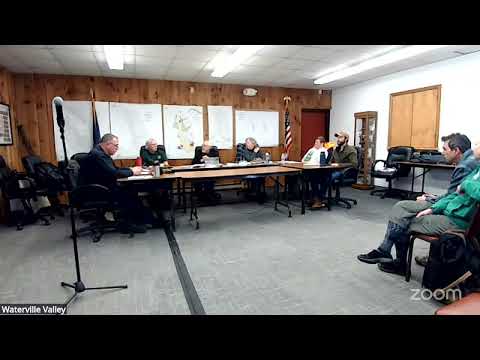
Waterville Valley Select Board pares proposed 2026 budget, weighing personnel cuts and fee changes
Summary
The Select Board met March 17 to reshape a $7.0 million operating budget mandated by town meeting. Officials focused on personnel costs, recruitment spending and wastewater staffing shortfalls while proposing discretionary cuts to recreation and exploring revenue options such as higher fees and revised commercial tipping.
The Waterville Valley Select Board on March 17 held a special meeting with department heads and the interim town manager to reshape the 2026 operating budget to meet a town‑meeting directive that limits the budget increase to $306,000, to a $7,000,000 total.
Chair Speaker 2 opened the meeting by explaining the constraint and the accounting rule that prevents the use of estimated revenues to offset expenditures in the March budget: “the select board was directed to limit the increase in the operating budget to $306,000,” and he spelled out that debt service rose sharply, noting debt service “increased $270,000” since 2025 as a primary driver of the constrained bottom line.
That debt pressure, staff and board members said, leaves little room for other lines. Speaker 2 said the board’s priority is to protect services and therefore to avoid cuts to personnel where possible, but that tradeoffs are unavoidable: “we are working with a flat budget year over year for all other expenses.”
Department heads and board members discussed scenarios for filling three vacant positions (wastewater and solid waste) at different fractions of a year. Finance staff Speaker 5 said spreadsheet modeling showed budgeting those vacancies as half‑year positions would reduce personnel costs by roughly $130,000 compared with budgeting three quarters of a year. The board asked staff to produce line‑by‑line numbers for quarter/half/three‑quarter scenarios before finalizing decisions.
Staff and the board highlighted a specific challenge recruiting certified wastewater operators. Speaker 4 described the labor market for operators as tight and aging: “the median age is 63 in the industry,” making it hard to recruit experienced operators without paying premiums or contracting out operations.
Because recruitment is expensive and time‑sensitive, the board debated a new recruiting line proposed at $50,000 for sign‑on incentives and outside placement help. Speaker 2 proposed trimming that to $30,000 for 2026 as a compromise, and members discussed whether recruiting should be treated as a one‑time expense funded by a warrant article in future years.
The board also considered trimming discretionary and program lines. Department heads offered specific cuts in parks and recreation (porta‑potties, holiday lights, a kiosk and some camp field trips) that together produced nearly $23,000 in savings; the group identified roughly $86,400 in departmental parts, maintenance and supplies that could be lowered and estimated about $150,000 in discretionary items as candidates for removal. Speaker 2 summarized, saying the current package of cuts would put the board near the required reductions but that additional savings were still needed.
Officials discussed revenue options to reduce long‑term pressure on the general fund, including raising recreational fees, rethinking commercial tipping and revising sewer fees so wastewater is funded more directly from users rather than by property taxes. Board members cautioned that moving revenue into fees shifts who pays and that some options would require longer planning or rule changes.
Residents who spoke during public comment urged the board to protect community programs. Leah of the Ray Center (Speaker 16) told the board the center had proposed a 10% operating reduction but warned deeper cuts risked the preschool and other services: “without the town support, the Ray Center will not be able to operate.” Other speakers proposed using town nonprofit structures or local foundations to preserve events such as fireworks and community nights.
The board closed its public business after roughly an hour and 20 minutes of budget work and voted to enter nonpublic session for negotiation purposes. Speaker 7 moved the motion and Speaker 2 seconded; the motion carried.
Next steps: staff will provide detailed quarter/half/three‑quarter cost scenarios for the vacant positions, revised recruiting and merit‑pay figures, and suggested discretionary cuts for the Select Board to finalize at the regular meeting scheduled for March 18 and for submission to the Department of Revenue Administration by March 30.