Get Full Government Meeting Transcripts, Videos, & Alerts Forever!
Get email alerts on the Housing Rent Policy topic
No spam. Unsubscribe anytime.
Seattle committee hears detailed case for banning "junk fees" in rental listings; developers warn of cost-shifting
Summary
At an informational July 8 briefing, tenant advocates urged a broad ban on hidden rental fees — pet rent, convenience charges and unadvertised monthly surcharges — while developers and housing providers supported transparency but warned bans could raise advertised rents and complicate housing production. Presenters outlined exemptions, enforcement and a July 2027 effective date.
Chair Dion Foster opened the committee meeting and invited an informational briefing on proposed rental-fee transparency and fairness legislation, which would generally prohibit rental fees unless specifically exempted and require disclosure of “all‑in” prices. No vote was taken.
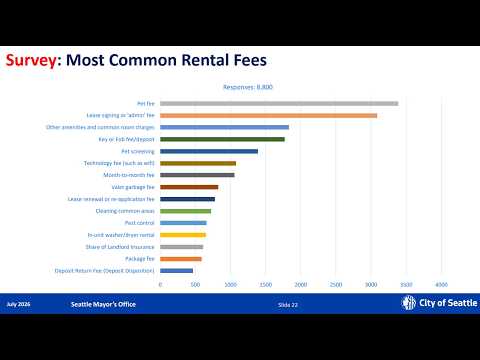
Tenant advocates and dozens of individual renters told the committee during a lengthy public-comment period that recurring and one-time ‘‘junk fees’’ — pet rent, application and screening fees, valet‑trash and technology or Wi‑Fi charges, package fees and some utility pass‑throughs — are widespread and make housing unaffordable and unpredictable. "This is not fair to us tenants," said Super Lib Morgan, a Seattle Housing Authority tenant. "Even SHA is getting you into the game of the junk fees. Ban junk fees," the speaker added.
Ariel Nelson, a senior attorney at the National Consumer Law Center, summarized research presented to the committee and described common fee categories and harms, including that recurring fees can become alleged rental debt and damage credit records. Professor Neil Mahoney of Stanford University told the committee that bundling mandatory fees into an all‑in advertised price reduces search costs and strengthens competitive pressure on landlords, and that well‑designed rules can lower total costs by increasing market transparency.
The mayor's office and Seattle Department of Construction and Inspections (SDCI) staff described the ordinance’s structure: a general prohibition on fees except in defined exemption buckets. Exemptions would cover categories already regulated under Seattle or state law (for example, security deposits and certain screening fees), limited recovery fees for demonstrable costs (key replacement, dishonored-check fees, lockout fees) and truly optional services that renters can affirmatively opt into (higher‑end Internet packages, third‑party amenities) provided those third‑party services are offered at cost.
SDCI staff emphasized enforcement design features: the agency could resolve similar building‑wide claims together to avoid repetitive individual hearings, there would be retaliation protections for tenants who complain, and an affirmative defense so a tenant cannot be evicted for refusing to pay an illegal fee. Presenters proposed an effective date of July 2027 to allow time for outreach and implementation and estimated startup costs under $200,000 and ongoing costs roughly $800,000 a year (about three FTEs and outreach), funded by a modest per‑unit fee of roughly $6 annually (about $0.50 per unit per month).
Housing providers and development representatives supported transparency but warned of unintended effects. "When you ban a cost, the cost doesn't disappear — it moves into rent," said Kevin Schilling of the Rental Housing Association of Washington, who urged the committee to keep disclosure requirements while rejecting blanket bans and some enforcement provisions he said would increase legal risk and housing costs. Developer Parker Nicholson said unclear and shifting rules make capital providers wary of investing in the city and urged caution so regulation does not deter new housing supply.
Council members probed national precedents, enforcement lessons and lease‑renewal mechanics. Presenters pointed to other local and state efforts (Bellingham, Olympia and some statewide rules in other states), described an FTC advanced notice of proposed rulemaking on rental fees, and stressed that disclosure alone is rarely sufficient without robust enforcement. SDCI staff explained that existing lease terms would not be disrupted until those leases expired or converted to month‑to‑month tenancies after the ordinance’s implementation date.
The committee accepted amendment concepts through July 15 and signaled a possible briefing and vote at its July 22 meeting. The ordinance remains an informational item; no formal action or vote occurred at this session.