Get Full Government Meeting Transcripts, Videos, & Alerts Forever!
Get email alerts on the Education Report Cards topic
No spam. Unsubscribe anytime.
Long Hill schools explain standards‑based report cards, say rubrics align with state tests
Summary
District leaders told parents the district’s standards‑based report cards measure progress on New Jersey standards, that rubrics align with NJSLA results, and that report cards for K–4 will be released Dec. 20; presenters offered concrete tips for parents to support learning at home.
George Alexis, superintendent of the Long Hill Township School District, opened a parent information session and introduced a presentation on the district’s standards‑based report cards.
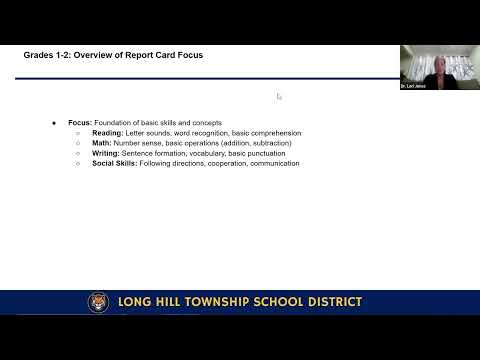
“Standards‑based report cards evaluate students based on their progress towards meeting specific academic standards rather than just a letter grade,” Jennifer Dawson, principal at Millington School, told parents during the session. She said the district is in its third year using the new format after grade‑level teacher committees reviewed templates and expectations.
Dawson and Dr. Jones, principal at Gillette School, said the district audited report‑card rubrics across grades and compared those classroom rubrics with New Jersey Student Learning Assessments (NJSLA) results. “We did find that the rubrics we use in our classroom and grading do align,” Dawson said, describing a random sample of students across proficiency bands the district used to check consistency with state test scoring.
The presenters reviewed the report‑card progress indicators: ES (exceeds standards), 3 (achieves standard), 2 (approaching), 1 (not meeting) and NA for skills not yet taught. They emphasized that a 2 early in the year can reflect an introduction to a skill rather than a failure to achieve the standard. For example, second‑grade items that reference early multiplication or skip counting may be marked as “approaching” because the full skill is introduced later in the year.
Presenters also described nonacademic ratings on the back of the report card, including work‑habits (cooperates, works independently, seeks help) and social competencies (respect, responsibility). These are graded as consistently, sometimes or infrequently; teachers will reach out to parents if scores indicate concern.
The session included specific guidance for parents: read with K–2 children daily and ask comprehension questions; practice basic math facts (up to 20 in first grade, up to 100 in second grade); encourage writing short reflections; monitor screen time; and use district resources such as I‑Ready and teacher Google Classroom assignments to support practice.
The district also advised parents that students begin NJSLA testing in third grade for reading and math, with science assessments in fifth and eighth grades, and that the report‑card rubrics are aligned to those state standards. Presenters encouraged parents with specific questions to contact their child’s teacher or the principals for clarification.
Dawson and Jones said report cards for grades K–4 will be released on Dec. 20; parents were told an RSVP survey for upcoming district events would be sent after the December break. The webinar recording and earlier sessions will be posted on the district website.