Get Full Government Meeting Transcripts, Videos, & Alerts Forever!
Get email alerts on the Local History topic
No spam. Unsubscribe anytime.
Teacher Kelly Brown recounts East Hampton mill era, immigrant labor and 1918 strikes
Summary
At Millside Park, Kelly Brown—an East Hampton High School social-studies teacher—told attendees about the West Boylston Company's arrival around 1900, rapid population growth tied to mill jobs, the recruitment of French-Canadian and Polish workers, the 1918 strikes (including arrests and National Guard involvement), and the site's later decline.
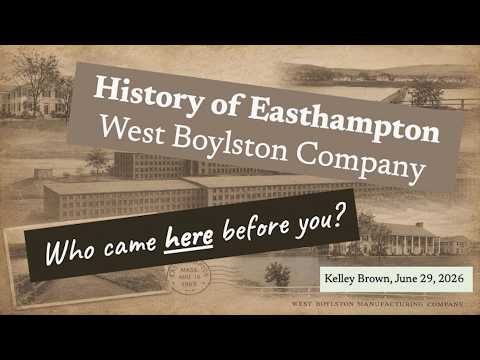
Kelly Brown, a social-studies educator at East Hampton High School, told a Millside Park audience that the West Boylston Company arrived around 1900, built multiple mill buildings on the site now hosting the event, and transformed the town’s demographic and industrial profile over the following decades.
"For the last 20 years at East Hampton High School, I've been doing local history with my students, and we've uncovered all kinds of amazing things," Brown said, then described photographs taken in 1912 by activist Lewis Hine that documented children working in the mills.
Brown said the company’s arrival coincided with a rapid population increase—roughly 5,000 residents in 1900, 8,500 in 1910 and 11,261 in 1920—and that the mill employed French-Canadian and Polish workers whom the company recruited to fill skilled and unskilled jobs.
The teacher recounted two strikes in 1918 during World War I, including an episode on July 18, 1918, when, she said, a crowd of strikers—mostly Polish women and children—gathered at Emerald Place, 36 women were arrested and the National Guard was called in. Brown said labor leader Joseph Rankins was arrested and sent to Fort Devens and inducted into the military.
Brown also said the company made concessions after unrest: raising wages and reducing the work week from 54 to 48 hours, and that it built a large recreation center for workers with bowling alleys, a soda shop, a post counter and an auditorium that hosted social clubs, sports and performances.
"This place was full and rich and amazing in terms of what was happening," Brown told the audience, describing weekly activities at the recreation center—baseball, billiards, girls' health leagues, baby conferences and more.
She said competition with southern factories led West Boylston to relocate in 1931 and that the recreation hall burned in 1932, marking the end of that mill-driven social era.
Why it matters: Brown’s presentation used local records and student research to connect physical features still visible at Millside Park to migration, labor and community life around the mills—information that shapes local identity and informs civic-education work in East Hampton.