Get Full Government Meeting Transcripts, Videos, & Alerts Forever!
Get email alerts on the Pesticide Ordinance topic
No spam. Unsubscribe anytime.
Resident urges ban on synthetic pesticides; local land trust warns ordinance would hamper invasive-species control
Summary
At a Westport Island Select Board meeting, resident Susan Gallagher urged voters to ban nonresidential use of synthetic pesticides citing health and environmental concerns. Andrew Morgan of Kelp (a local land trust) and conservation members countered that the ordinance as written would remove trained tools for rapid invasive-species response.
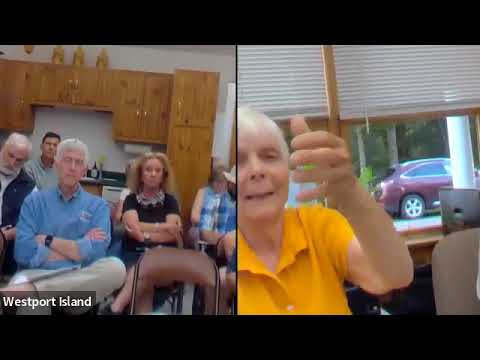
At a Select Board meeting, resident Susan Gallagher urged the community to adopt a warrant article that would prohibit the nonresidential use of synthetic pesticides on Westport Island, saying the proposal puts a community standard before potential environmental and health risks.
"Should synthetic pesticides be used on nonresidential lands in Westport?" Gallagher asked, summarizing the core question she said the ordinance asks of voters. Gallagher, who described a 40-year career in the food industry and experience with chemicals and pesticides, said recent scientific debate about glyphosate and actions by regulatory bodies justify a precautionary local response.
The proposal prompted a detailed presentation from Andrew Morgan, who identified himself as the land stewardship director for the Kinabag History Land Trust (referred to in the transcript as Kelp). Morgan and his colleague Dylan Mulhern told the board their organization uses targeted, minimal herbicide applications as one component of integrated-pest management and that the warrant, as written, would remove professional options needed for rapid eradication of dangerous invasives.
"This ordinance, as written, would inhibit Kelt and other partners from having the same rapid response success on Westport Island as we had in Georgetown when new and emerging species show up," Morgan said, describing past coordinated responses with state invasive-plant specialists.
Speakers from the planning and conservation community said the issue involves trade-offs. Jeff (a planning-board participant) relayed guidance from a Department of Environmental Protection workshop, saying that in some shoreline and slope situations manual removal can cause more harm than carefully applied herbicides. A conservation-commission member echoed concerns about scale: while manual removal is appropriate in many locations, some invasives require professional treatment to avoid long-term habitat loss.
Board members emphasized that the evening was informational and that the Select Board itself would not vote as a body on the warrant; instead, individual board members will cast votes at the town meeting this Saturday. One board member asked whether the proposed ordinance had received legal review; no definitive legal clearance was reported during the discussion.
The Select Board encouraged further public education and dialogue, and several presenters — both the ordinance proponent and representatives of Kelp — offered to continue conversations and provide additional information ahead of the public vote at Saturday’s town meeting.
The matter remains before voters at the upcoming town meeting; the Select Board did not take a formal vote on the ordinance at this session.