Get Full Government Meeting Transcripts, Videos, & Alerts Forever!
Get email alerts on the Land Use Zoning topic
No spam. Unsubscribe anytime.
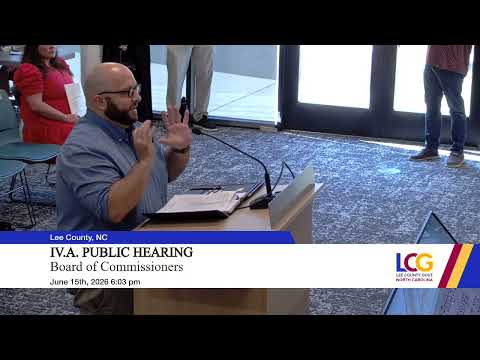
Lee County hearing on UDO updates draws dozens of residents urging moratorium on proposed data center
Summary
Planning staff presented a Unified Development Ordinance text amendment that county officials said makes mostly formatting and interjurisdictional clarifications; dozens of residents used public comment to press commissioners to halt data centers, citing noise, water and health concerns and calling for a temporary moratorium.
Thomas, a county planning presenter, told the Lee County Board of Commissioners on June 15 that the proposed Unified Development Ordinance (UDO) text amendment is intended largely to align the county's code with the Plan San Lee long‑range plan and to improve readability. Thomas said most substantive changes affect the city of Sanford and the town of Broadway and that unincorporated Lee County would see “minimal substantive changes.” He walked the board through formatting and permitted‑use matrix edits, renaming the R20 zoning district to RN20 (affecting about 55 parcels), tightened rules on lot width-to-depth ratios, a clarified exemption for cul‑de‑sac lots, limits on side‑by‑side access easements, new open‑space definitions (active versus passive), a 20‑foot perimeter tree preservation buffer for major subdivisions (10 acres+), and a prohibition on creating lots in mapped floodplains for major subdivisions.
Why it matters: Several aspects of the amendment affect how future subdivisions and commercial uses are reviewed in both city and county jurisdiction; residents said the changes — plus language permitting data centers in some industrial categories — could allow a very large data center project to advance through an administrative approval pathway they view as insufficiently transparent.
During the public comment period that followed the staff presentation, many residents concentrated on a single project and on how the UDO language could affect data‑center permitting. Bradley Reed told the board he and other residents had repeatedly asked commissioners to oppose the project and to adopt a moratorium. "The Deep River Data...is attempting to tap a natural gas reserve in Northern Lee County to power an AI data center," Reed said, urging commissioners to "enact a moratorium." Jonathan Boyce, who said his family lives within walking distance of the proposed site, called the project a "fundamental threat" to the county and raised health fears tied to infrasound and electromagnetic fields. Several speakers — including Donna Evanson and Terrell Johnson — asked the board to study other jurisdictions' permitting approaches and to consider a separate special‑use classification for data centers so they do not "slip in under the radar." Laura Duck and others raised concerns about transparency and non‑disclosure agreements that, in their view, obscured developers' roles and prevented meaningful citizen review.
Planning staff and other officials answered procedural questions during the meeting but did not take a final vote on the text amendment. Thomas and other staff clarified that certain matters, such as whether a subdivision meets technical standards, are administrative; if a plat meets the standard, staff generally approve it. Elizabeth, speaking later on a separate contract item, and other county officials told the board the county retains the authority to consider moratoria and that a legal pathway exists to impose one, but she emphasized legal limits and the need for a clear statutory basis when asked about immediate action.
Quotes that capture key positions: "Every vote cast in favor of this development is a vote against the people who elected you," Bradley Reed said. Jonathan Boyce said: "Are we committed to a future where our children and grandchildren can grow up healthy?" Planning presenter Thomas described the amendments as primarily aimed at readability and interjurisdictional alignment: "These UDO updates are primarily geared towards addressing increased residential growth for the city of Sanford, and the goal from the outset was to minimize impacts to Lee County residential development standards."
What happened next: The board opened the public hearing on the UDO text amendment, allowed the public a chance to speak specifically on the amendment, then closed the hearing and proceeded to the public comment period. No final action on adopting the UDO text amendment was recorded at the meeting; planning staff and the planning board were scheduled to continue work on the item after the hearing.
Context and outstanding questions: Residents repeatedly asked for a moratorium while noting petitions and prior planning‑board votes; petition organizers told the board they had collected roughly 600 signatures. Citizens asked the county to study operational impacts of a facility of the size described in public comments (questions about water consumption, emergency response capability, noise standards, e‑waste disposal, and greenhouse gas emissions were all raised). County staff said some of those operational impacts involve state law and utility infrastructure beyond the county's direct control. The board did not adopt immediate regulatory changes at this meeting; the record shows robust public demand for further study and for a formal moratorium if the board wants time for additional analysis.
Attribution and sources: Quotes and attributions in this story come from the public record of the June 15 Lee County Board of Commissioners meeting. Speakers quoted by name are listed in the meeting transcript and appear on the board's public‑comment roster. The article does not attribute technical claims (for example, specific health effects or precise water‑use numbers) beyond the speakers who made them; those claims were contested by other commentors and were not resolved at the meeting.
Next step: The board closed the hearing and continued with other agenda items; the UDO text amendment remains before planning staff and the planning board for follow‑up and possible future action.