Get Full Government Meeting Transcripts, Videos, & Alerts Forever!
Get email alerts on the Fire District Transition topic
No spam. Unsubscribe anytime.
Caldwell officials weigh shifting fire services to rural district amid budget squeeze
Summary
At a city workshop, Caldwell leaders and fire chiefs discussed options to sustain fire services — annexation to the Caldwell Rural Fire District, forming a new district, or levy measures — and outlined legal, timing and budget tradeoffs if the city moves forward.
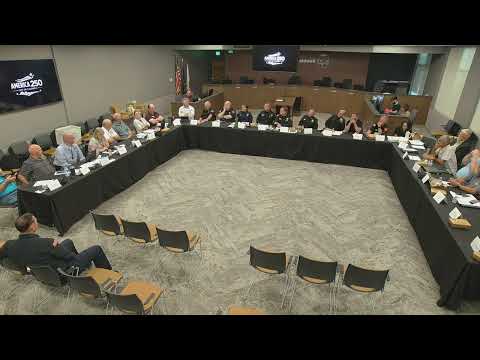
Caldwell officials, fire chiefs and legal and finance advisers gathered at a June workshop to examine whether the city’s fire department should transition to a rural fire district, a move officials said could increase long‑term funding but would require complex legal and budget work.
Mayor Eric Phillips convened the session and councilors heard presentations from Chief Greg Tominski, who outlined how recent state legislation (cited in the meeting as changes from House Bill 389 and technical fixes in HB 959 and HB 765) reduced the budget authority of some taxing districts and created new constraints on transferring municipal budgets. “Starfire Protection District… has lost $3,200,000 to date from a budget authority since House Bill 389 went into effect,” Tominski said, urging careful legislative fixes and noting that current annexation language would cause a roughly 10% loss of transferred funds unless changed.
Caldwell Fire Chief Brian Daniels and other panelists described operational shortfalls the department faces: Daniels said the department is on track for about 9,200 calls this year and that staffing shortfalls identified in an ESCI study leave the department roughly 24 personnel below benchmark. Tominski warned that apparatus and equipment costs have risen sharply — “fire engines run about $1,200,000 to $1,500,000 each” — and that current local revenue mechanisms leave few alternatives to property tax increases.
Chief Wendelsdorf (representing the rural district) walked the council through a coverage map and the mechanics of annexation, noting the two‑year lag in assessed values and the need to negotiate asset transfers, union exit/entrance agreements and IT and payroll arrangements. He projected that annexing the city under current law could produce additional levy revenue but cautioned that the statutory use of the term “annexation” rather than “consolidation” affects how much of the city’s budget would transfer immediately.
Chief Kirk Carpenter of the Nampa Fire District described that city’s recent move to a district as a case study, saying the shift allowed the district to open stations faster and reduce average response times. “Our response times have gone down almost 2 minutes on average,” he said, attributing the improvement to dedicated, predictable tax funding and more focused capital planning.
Councilors repeatedly pressed staff on timing. Some members, citing the city’s tight near‑term budget, favored a more expedited process to allow one‑time city support for transition costs; others and several chiefs urged caution. Tominski and Carpenter cautioned that rushing risks losing negotiated details: “If we miss a step, if we rush something, we miss a detail, it could set us up for failure,” Tominski said.
City finance staff and outside municipal advisers flagged key implementation tasks — mapping district boundaries, resolving urban renewal/TIF impacts, transferring bonds and leases, separating IT systems, and defining which city services the new district would contract for during an initial transition year. Staff said a consultant and a clearly resourced work plan would likely be needed to prepare legal agreements and cash‑flow modeling for council consideration.
Mayor Phillips and staff plan to ask the rural commissioners to consider a brief report and then return to the council with a recommended next step. The council set a follow‑up presentation and potential action item for its July 20 meeting.
The workshop produced no formal decision on a transition; it closed with a request for staff to prepare a report outlining costs, timelines and required legal changes so elected bodies on both sides can decide how — and how quickly — to proceed.